
Marjorie Raymond: Transforming emotion into monumental abstract art
Emotion becomes textured abstraction in works now seen in exclusive spaces
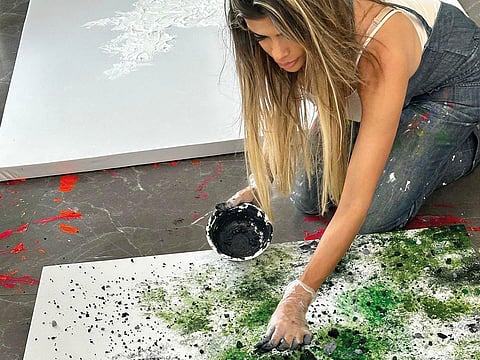
Emotion lies at the heart of Marjorie Raymond’s art. The French artist, raised in Brazil and now based in Dubai, has spent more than 25 years transforming lived experience into monumental abstract works layered with sand, charcoal, stone and diamond dust. Her canvases possess an unmistakable physical presence, which explains why they now appear in distinguished private collections across Europe, Asia, the Middle East and the Americas, as well as in spaces such as Bvlgari Mansions and Villas, Atlantis The Royal Penthouse and Nammos Beach.
Raymond’s artistic language has been shaped by the cultural landscapes she has lived within. Born in France, raised in Brazil and now immersed in Dubai’s cosmopolitan environment, she describes each place as leaving a distinct emotional imprint on her perception of the world. “Living across France, Brazil, and now Dubai has shaped not only how I see the world, but how deeply I feel it,” she says.
Her work begins not with observation but with feeling. Raymond approaches abstraction as a direct translation of emotion into material form. “My work is rooted in emotion. I do not paint what I see; I create what I feel,” she explains. Through large-scale canvases and sculptural forms, she channels memories, cultural contrasts and personal experiences into surfaces that carry both physical and emotional depth.
I no longer create to prove anything, I create to express.Marjorie Raymond
Texture forms the foundation of this language. Raymond builds her works through layers of materials such as sand, rocks, charcoal and diamond dust. These elements function as expressive tools rather than decorative flourishes. “The materials I use are never there to decorate a surface,” she says. “I use them to express as intensely as possible what I am feeling.”
This layered intensity often triggers an immediate reaction from viewers. Raymond pays close attention to the emotional exchange between artwork and audience. “When people stand in front of my work, they usually feel something immediate and powerful,” she says. The goal is not quiet contemplation but a lasting impression. “I do not want the work to leave anyone indifferent. It should have presence.”
Collectors have taken notice of that presence. Raymond acknowledges the honour of seeing her work placed in prestigious residences and luxury environments alongside internationally recognized artists. These spaces, however, never influence her creative decisions. “Artistic integrity is non negotiable for me,” she says. “The environment does not dictate the work.” Her process remains unchanged whether a piece is destined for a private residence, a penthouse or a gallery setting.
Raymond rejects the idea that luxury art must soften its emotional force. She believes depth and authenticity define true sophistication. “True luxury, in my view, is not about decoration,” she says. “It is about depth, presence and emotional impact.”
Over 25 years, her practice has evolved alongside her life experiences. Moving between cultures, becoming a mother and navigating different stages of life have expanded her emotional awareness. “What has changed most is my emotional maturity,” she says. The shift has brought greater clarity to her work. Technically she has grown more confident, and philosophically she feels more grounded. “I no longer create to prove anything,” she explains. “I create to express.”
That conviction shapes how she views creative independence, especially for women pursuing artistic careers. For Raymond, independence begins with trusting one’s voice even when it challenges expectations. “Creative independence is the courage to stand firmly in your own voice,” she says. She encourages young female artists to remain curious, explore different techniques and resist the urge to rush the process.
“Do not shrink your vision,” she advises. “Trust your instinct. Keep creating. Your voice will expand in ways you cannot yet imagine.”


