
Constant photo documentation is changing how people notice and cope with hair loss, experts say
Endless selfies and resurfaced photos make thinning hair harder to ignore
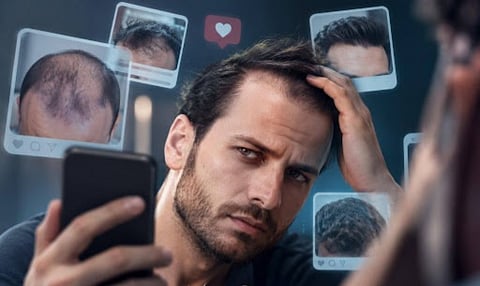
Hair loss has always been gradual. What has changed, according to psychologists and clinicians who study self-perception, is how quickly people now notice it and how hard it has become to avoid noticing.
The shift traces back to a simple fact: the average person now has access to thousands of photographs of themselves, spanning a decade or more, searchable, sortable by face, and frequently resurfaced by apps without being asked for.
A generation ago, most people had only a handful of photos taken each year. Today, an old headshot, a video call thumbnail, or a tagged photo from a friend's camera roll can appear unprompted, placing a much younger image directly next to the one in the mirror.
An unplanned visual record
No single platform or company designed this outcome. It emerged from the accumulation of smartphone cameras, social media "memories" features, professional networking photos, and video conferencing technologies built for other purposes that, together, created something new: an involuntary visual timeline of aging.
Researchers who study identity have long argued that a person's sense of self depends partly on continuity the feeling that the person in today's mirror is recognizably the same one from yesterday. When that continuity is interrupted by a photograph that doesn't match a person's mental self-image, the effect can go beyond simple vanity, touching a more basic sense of psychological stability.
Why hair loss in particular
Clinicians say hair loss is especially exposed to this effect because it has traditionally been a private, slow-moving change something that used to require an old photo pulled from a drawer, or a friend not seen in years, to notice. Now, a resurfaced photo can arrive at any time, on any platform, often algorithmically selected to maximize engagement.
The result, according to people who treat hair loss professionally, is a condition that feels psychologically heavier today than it did two decades ago, even though the underlying biology is unchanged. What has changed is the frequency and involuntariness of the visual evidence.
The clinical response
Waleed Taleb, co-founder and CMO of Istanbul-based Vera Clinic, said in an interview with Arab Insights Care Magazine that the outcomes he considers most meaningful are not physical but psychological: patients describing regained confidence after years of feeling it was lost.
Vera Clinic has built part of its reputation around shortening the visible recovery period after hair transplant procedures. The clinic says it pioneered Sapphire FUE in Turkey, a technique using sharpened sapphire tips rather than traditional steel blades to make smaller incisions, reducing visible trauma and shortening healing time. It later introduced Vector-10, a surgical tool using lab-grown diamond components, aimed at further increasing precision.
The clinic was named Turkey's best hair transplant provider by the European Award in Medicine.
A broader pattern
Clinicians and researchers describe this as part of a wider pattern affecting how people experience visible physical change generally not just hair loss. Dating apps require current photos alongside older ones. Professional networking profiles invite direct before-and-after comparison. Video calls place a live image of oneself on screen for the duration of nearly every meeting. None of these platforms were built with any single physical change in mind, but collectively they have reduced the space in which people can experience gradual change privately.
For clinics and researchers alike, the takeaway is less about vanity than about recognition the psychological experience of seeing oneself in a photo and immediately knowing it as accurate. When that recognition breaks down, experts say, treatment discussions tend to center less on appearance itself and more on restoring a felt sense of continuity between the person someone believes themselves to be and the person who keeps showing up in their photos.


