
Zoltan Istvan on transhumanism and the future of living longer
Why transhumanists say science could soon let humans outrun ageing itself
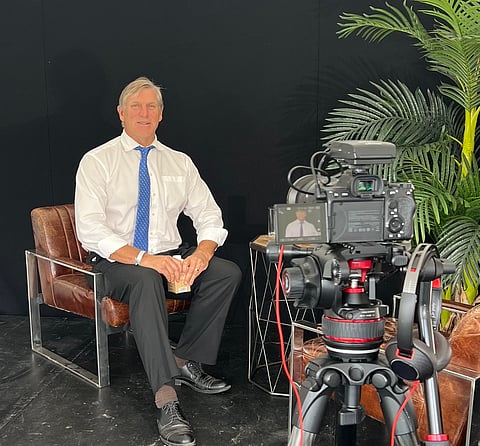
I am intrigued when I discover that transhumanist advocate Zoltan Istvan quite literally walks the talk when it comes to using technology to improve life. At first sight, he hardly looks like someone who might have stepped out of a science-fiction novel. Dressed in a white shirt, black trousers, and a grey tie, he appears every bit the polished conference speaker — one of the headliners at the recently concluded Future Summit in Dubai. But a few things he mentions on stage immediately catch my attention: transhumanism, Longevity Escape Velocity, why he believes humans will soon live beyond 100, why he once ran for US President… and the chip he had injected into his hand.
Zoltan smiles when I mention the last one and raises his hand to show me the faint rectangular bump on the skin above his thumb. “See that tiny ridge? That’s it,” he says. The chip was inserted with “something like a large horse syringe,” he adds with a laugh.
What does it actually do? “For starters, with a wave of my hand, I can unlock my home,” he explains. He can also start his car, store Bitcoin, and even share his business card via NFC. Inside those few millimetres of silicon sit his medical records, personal data, and more. For Zoltan, the chip isn’t a party trick. It is a statement of belief.
To understand that belief, one must understand the man. Born in Los Angeles to Hungarian immigrant parents, Zoltan is a writer, journalist, philosopher, and futurist. An explorer at heart, he has travelled to over 100 countries, many as a National Geographic journalist. His work has appeared on CNN, FOX News, and BBC, the latter profiled him extensively during his run for US presidency.
In 2017, he made headlines when he ran for the US presidency as the candidate of the Transhumanist Party, driving across America in a coffin-shaped bus. It was less gimmick, more philosophical provocation. The “Immortality Bus” symbolised humanity’s biggest problem: death. He didn’t win. Donald Trump did. But Zoltan wasn’t done. In 2019, he entered the Republican primaries, again challenging Trump, this time with the campaign motto Upgrading America. He later admitted the goal was less political and more conceptual: forcing the world to confront a radical question: what if dying wasn’t inevitable?
At its core, that is what transhumanism is. A blend of science, philosophy, and bold futurism, it imagines a world where artificial intelligence, genetic engineering, robotics, and biotechnology don’t merely improve our lives; they redefine what it means to be human. Biological immortality, Zoltan believes, is possible; and within reach. “I’m talking about within the next five to eight years,” he says, smiling. A future where diseases are cured, aging is optional, and if the body fails, one might upload the mind to a machine and continue living virtually.
“I live what I preach,” he tells me, settling comfortably in his chair. The chip beneath his skin is both proof of concept and personal conviction. “It’s convenience, yes,” he admits, “but it’s also saying: this is where humanity is headed. If we can merge with our tools, why wouldn’t we?” Technology, he argues, isn’t separate from us; it is an extension of our hopes, fears, and ambitions.
Transhumanism, he insists, isn’t about sci-fi fantasies of cyborgs. It is about human choices: choosing to enhance biology, choosing to live longer and healthier, choosing to integrate technology when it meaningfully improves life. And while critics dismiss these ideas as futuristic, Zoltan points out that society already uses embedded and wearable technology: pacemakers, insulin pumps, AI-powered hearing aids, why, even spectacles. “We’re already halfway there,” he says. “I just make it more visible.”
So what makes transhumanism urgent? “People are dying,” he says plainly. “Around 150,000 people die every day from what we call natural causes. But transhumanists don’t accept the word ‘natural’.”
He speaks from personal loss. “My father died six years ago from a heart attack. There was nothing natural about that. Science could have saved him, extended his life, maybe indefinitely. Yet we accept aging as normal. Transhumanists disagree.”
Zoltan believes that in 10–15 years, humanity will overcome biological aging. He recounts the death of a child in his San Francisco neighbourhood from leukemia. “To me, that wasn’t natural. If we spent more money on science instead of war, maybe that child could have lived. Why not have a war on aging, on diabetes, Alzheimer’s, cancer? Those are the wars that matter.”
Zoltan’s worldview was shaped by his early years reporting in war zones and remote regions for National Geographic. “When you cover war and see death, you realise how important it is to prolong life,” he says. “If you love life, you’ll do everything to avoid dying.”
But immortality raises ethical and philosophical questions, I argue. Overpopulation, for one. “If we stop dying, we must rethink resources and maybe colonise space,” he acknowledges. Social structures too will evolve - marriage, family, careers - if people remain biologically 40 indefinitely. “Society will change profoundly. But saving lives is always better than losing them. We’ll adapt.”
Which comes first: curing diseases or reversing aging? “Curing disease,” he answers. “We can already bioprint tiny beating hearts. Soon it’ll be kidneys, livers, lungs. If we can anticipate and replace failing organs, we’ll add decades of healthy life.”
Among emerging technologies, which will reshape humanity most in the coming decade? Zoltan doesn’t hesitate. “AI. It’s the 800-pound gorilla. But organ bioprinting will be just as transformative. My family has a history of heart conditions. If I can print a new heart when mine wears out, that’s decades of extra life. It’s about preventing suffering.”
Does the prospect of embedded chips or merging with machines scare people? “Of course,” he says. “Fear is natural. Every leap in history faced resistance. But you don’t have to do it. Transhumanism is about offering choices, not imposing them.” His own implant doesn’t turn him into a superhero. “It’s like wearing glasses,” he says. “Once, that was considered unnatural. Now it’s normal. The question is: what are we willing to normalise next?”
In 10 to 15 years, the global average lifespan could reach 100, he predicts. We are also moving toward “longevity escape velocity”- the point at which medical advances extend life faster than time takes it away. “At that point,” he says, “you could live healthy and active indefinitely.”
As our conversation draws to a close, my eyes return to the tiny bump above his thumb. How long before chips like his become as commonplace as smartphones?
“That’s the dream of transhumanism,” he says with a smile. “Not just longer lives, but better ones.”


