
The Kolkata kid who became Asia’s best chef
Instead of an apron, chef Gaggan Anand sports goggles in his lab, where he creates award-winning dishes
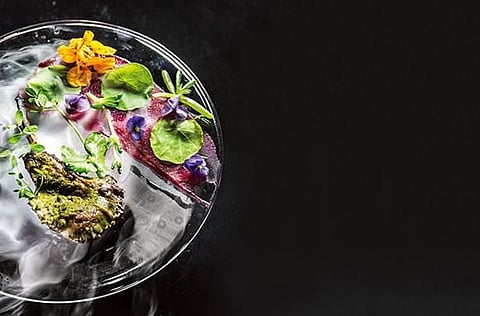
There is a love story Gaggan Anand tells that somehow seems to sum him up. Five years ago, just a couple of weeks after the Kolkata-born chef had opened his restaurant in Bangkok, Thailand, a girl he was smitten with told him she was going there for dinner.
She didn’t know it was his place, and he didn’t bother to tell her. All that night – all through the 23 courses that make up every meal served there – he made sure he stayed in the kitchen, out of sight.
Then, when it came to her final dish, he sent out a specially prepared bowl of smoked ice cream – the girl’s favourite.
‘I snuck out and stood behind her as she was trying it,’ he says. ‘And I heard her saying “Oh wow, I’m going to marry this chef”.’
He laughs. ‘She did too. Two years later. What can I say? That’s the power of food. It’s seductive.’
Gaggan doesn’t quite explain why the girl in question – now his Thai wife Pai – didn’t connect an Indian chef she knew called Gaggan with an Indian restaurant also called, er, Gaggan.
But it doesn’t really matter.
The themes within – romance, culinary experimentation, food as an expression of feeling – are all symptomatic of his story. And it’s quite some story.
Born in an impoverished neighbourhood to a labouring father and housewife mother, he was nicknamed The Titanic as a child – ‘because no one thought I’d get very far’.
‘How did it feel to be number one?’ the 37-year-old ponders today. ‘How can I describe it? I was crying. It was the result of so many years of hard work.’
Since that magical night in Singapore, the 55-cover restaurant has been so in demand that there’s currently a six-week waiting list for a table. He says he’s had to turn away Bollywood royalty because they’ve arrived without booking. ‘I had one guy – and I won’t name him – he says to me, “Do you know who I am?” and I say “I know who you are, I’m a big fan, but I have to queue to see your movies and you have to queue to eat my food”.’
So, how did Gaggan get so good? How, when India is a country of a million chefs and Asia a continent of a million more, did he get to be number one? Hard work, undoubtedly. Passion, for sure. Seizing opportunity, definitely.
But it was also down to his desire to challenge accepted norms about his country’s food. He will often riff on a theme: that the food heritage of India is rich and delicious but no one has ever tried to move it forward; make it progressive. Gaggan’s calling card is to take the street dishes he remembers from his Kolkata childhood, deconstruct them, chemically alter their make-up in some cases, and then recreate them as something both highbrow and highly unusual.
His obsession with experimentalism means he calls his kitchen a lab. In there, there’s a blowtorch, a dehydrator and a liquid nitrogen pump. Quite often he doesn’t wear an apron, he wears protective glasses.
‘I call my style playful,’ he says. ‘Playful and a bit naughty. Everything comes from my memory, from my childhood, but I take that and I create something completely unique.’
And it is to music he refers when I ask about the 23-course meals he serves. ‘I want you to love every one of those courses but if there are just two or three that are so good you know you’ll remember them forever, remember the moment, remember how you felt when you were eating them, then I am happy,’ he says.
He likens this process to listening to American progressive metal band Dream Theater’s music. ‘They have one song that lasts 18 minutes and every bit of that song is sublime, every single second is magical. But there are these three minutes that are beyond even that. For those three minutes you would do anything to hear them again. I want my food to be like that.’
He arrived in Bangkok in 2007 for a three-month consultancy, fell in love with the place (‘you live here, you really live like nowhere else’) and never left. Then on a night out in 2009 – frustrated with the lack of creativity in his then post – he proposed to a couple of associates that they open a restaurant. They agreed.
He spent the winter training at the legendary elBulli restaurant in Catalonia, a place named the world’s best restaurant for five years. ‘I had to phone 15 times before I got to talk to someone who could speak English. But I didn’t care. That place had become my guiding star. There was nothing going to stop me from spending time there, and learning from these masters.’
He returned to Bangkok and opened Gaggan in 2010, and his reputation has been growing since. His refusal to do any TV despite his mounting accolades (‘people keep asking but I don’t have time, I want to be in my kitchen’) has only made his appeal greater. Next year he plans to open a curry house in Mumbai, which will be more of a traditional restaurant, run by a chef trained by him in Bangkok.
And yet…
Gaggan was opened five years ago now. He once told an interviewer that ‘every restaurant reaches its peak in six years’, and he told another he would bow out while at his best.
Does that mean the place will close next year, I wonder. He laughs and backtracks. This is a man clearly too in love with what he’s doing to stop just yet.


