The Dhoom Dhaam effect: Why this Netflix rom-com is more than just love and laughter
Beneath its breezy, entertaining surface, the film subtly challenges long-held stereotypes
Dubai: Every day, she feared being molested. Her brother’s only fear? Being late to class.
Bollywood director Rishab Seth, in an interview with Gulf News while promoting his hit Netflix rom-com Dhoom Dhaam, recalls this chilling conversation with his sister—one that forever shaped his understanding of gender disparity.
"My sister and I went to the same college in India. She’s four years older than me, and she once told me that every day when she got on a train, she worried about getting molested. Every single day. Meanwhile, my only concern was getting to my lecture on time. That contrast never left me. It’s something men will never fully relate to."
This harsh reality is precisely what his highly engaging Dhoom Dhaam captures in one of its most compelling moments—a monologue by Yami Gautam’s character that lays bare the constant struggles women face.
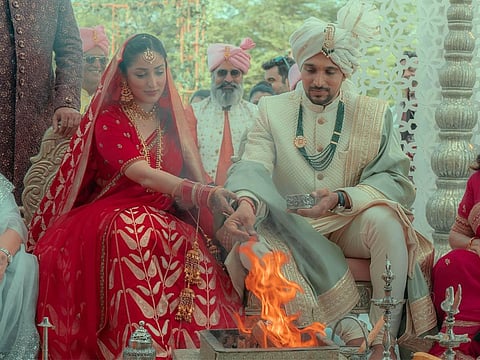
The scene, which has since gone viral, sees Yami’s character calling out her new husband, played by Pratik Gandhi, for claiming to understand a woman’s daily battles. Her sharp words, combined with Pratik’s silent, stunned reaction, have sparked conversations online, with men and women debating its impact and truth.
This moment encapsulates what makes Dhoom Dhaam more than just another feel-good rom-com.
Beneath its breezy, entertaining surface, the film subtly challenges long-held stereotypes—about masculinity, relationships, and societal expectations. In a genre where Bollywood heroes are often hyper-masculine, Veer is refreshingly different. He is gentle, self-assured, and entirely comfortable standing in the shadows while his wife shines—a direct counterpoint to the aggressive, dominant male leads celebrated in films like Kabir Singh and Animal.
The cast and creators of Dhoom Dhaam are keenly aware of this shift.
“Yes, it was a conscious call. In fact, this is absolutely something that we wanted to communicate to the audience without being preachy,” says Pratik Gandhi.
“On the same lines that these days actually being nice, being good is not well taken in the world. People say, ‘he’s too simple a guy, too nice a guy.’ And I think the world needs more of such guys these days. You need nice guys around you, right?”
Director Rishab Seth adds, “We've actually had a lot of these discussions after the release of the film, or rather leading up to the release of the film. We realize what an exemplary character Veer is—he doesn’t feel any shame in sharing his vulnerabilities. We have a character who’s very happy playing second fiddle or sitting in the back seat, and he’s comfortable. It’s okay if my wife takes charge, I’ll stand behind her. And there is no shame in that.”
Adding another layer to the film’s themes is its take on arranged marriages. While Bollywood has long romanticised the idea of strangers falling in love post-marriage, Dhoom Dhaam presents a more grounded take. It explores the awkwardness, the uncertainty, and the slow process of discovery that comes with such unions.
“If there was any messaging in the film about marriages, it’s more about how marriage is a constant discovery,” says Rishab Seth.
“In the case of Veer and Kaavya, that whole process gets really accelerated. What might normally take years for a couple to learn about each other happens to them in one night.”
The film’s unexpected casting choices also contribute to its charm. Yami Gautam, known for her sharp performances, brings both wit and emotional depth to her role, while Pratik Gandhi—best known for his gripping portrayal of stock market scamster Harshad Mehta in Scam 1992—proves his versatility with impeccable comic timing.
“For us, Pratik was literally our first choice for Veer,” says Rishab.
“It’s funny, because you say he’s an unexpected choice, but for us, he was the most obvious choice. We were lucky that he read the script, enjoyed the space, and wanted to do a comedy.”
Another standout aspect of Dhoom Dhaam is its ability to balance humor with social commentary. The film doesn’t hammer its messages home but instead lets them seep in through well-crafted dialogues and relatable moments. Whether it’s the playful yet pointed swipe at arranged marriages or the celebration of “nice guys” in a world that often overlooks them, the film’s underlying themes resonate deeply.
Bollywood has been in a state of flux, with filmmakers and audiences questioning what kind of stories deserve the spotlight. While some directors are heading south for inspiration, Dhoom Dhaam serves as a reminder that Hindi cinema can still deliver fresh, entertaining, and meaningful narratives.
“The feedback has been overwhelming,” says Pratik.
“Thanks to Netflix, we’re getting love from around the world. I even received an email from someone in Costa Rica praising my performance. It’s incredible to see how universal the appeal of a good story can be.”
Like they said, Dhoom Dhaam works because its leads aren’t afraid to show their flaws or vulnerabilities. It challenges the stereotype of brides as modest, obedient figures and men as their saviors, offering a more nuanced take on modern relationships. Put a ring on this one.
Don't Miss It!
Dhoom Dhaam is out on Netflix now


