Portraits of the women of Afghanistan
They’re rarely seen, but photographer Lana Šlezić managed to persuade some Afghan women to pose for her
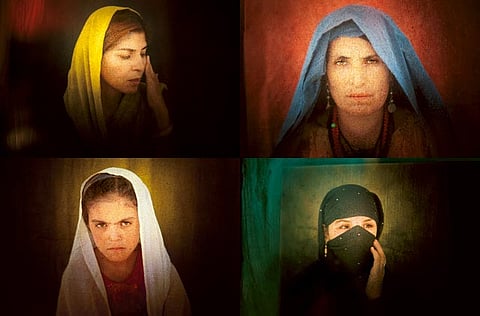
Photographer Lana Šlezić’s portraits of Afghan women are the epitome of contrasts. The women’s exquisite features and colourful attire are in
stark contrast to the pain that clouds their faces. But amazingly, what also comes through in all the pictures is the women’s stoic fortitude, sheer willpower and calm determination to overcome all the hurdles they face. And for them there are plenty.
Since the fall of the Taliban regime in late 2001, there were reports that the political and cultural position of Afghan women had improved. The Afghan constitution states that all citizens have equal rights and duties but in some cities and especially rural areas in Afghanistan, many challenges remain. Lana discovered that girls are denied an education and domestic violence is commonplace.
She should know. A 38-year-old World Press Photo Competition prize-winning Canadian of Croatian descent and mother of two, she first arrived in Kabul, Afghanistan’s capital, in March 2004 commissioned by Canadian Geographic magazine for a project on the Canadian military who were based there
at the time.
During the six-week assignment she caught glimpses of women on the street and was motivated to capture their stories so she ended up staying for two years interviewing a cross-section of women. The result was her first book Forsaken – a collection of shocking, often disturbing, stories of Afghan women illustrated with photographs. The book received critical acclaim with The American Photo Magazine rating it as one of the Best Photo Books of the year. But that wasn’t enough for Lana.
“The two years I spent in Afghanistan were focused on capturing heavily emotional stories and circumstances of the women. This drained me emotionally and after publishing the book I experienced a feeling of emptiness within,’’ she says. Lana returned to Canada with a heavy heart. “I wanted to go back and this time capture the positivity of the women.
I wanted to do something more for the women there.”
So, in 2007, Lana returned to shoot portraits of Afghan women. “In a way it was a healing process... to show these women as beautiful and incredibly strong.”
The result of that project will be showcased in Dubai at an exhibition entitled A Window Inside at the Gulf Photo Plus Studio in Al Quoz from September 10 to October 25.
Making an impact
While the images are striking, they also portray the strength of the women, something Lana says she achieved by using a unique technique – taking digital pictures of an image reflected on the viewfinder of an Afghan archaic box camera. “I photographed the reflection of the women in the ground glass of the viewfinder of the box camera using a slow shutter speed,’’ she says. The result is a portrait which is akin to an oil painting.
A cathartic work
“This series of portraits is a kind of tribute to [Afghan women]. I suppose I was creating a personal and everlasting bond...in a photograph,’’ says Lana, whose work has been exhibited across the world from Japan to New York and published in several major publications including National Geographic, Time and Newsweek.
“For Forsaken I lived in Afghanistan for two years and wrote short stories and had extended captions for each image. This one is completely different,” she says. “This is less literal, less documentary and less journalistic. This body of work was actually the way I made peace with Afghanistan – it was a very emotional and painful two years during Forsaken and I had to go back and heal with A Window Inside.
“I wanted people to know that even in the most dire circumstances there is something in the core of Afghan women that is beautiful and strong. I wanted to emphasise that in a way that Forsaken could not.
“The situation of these women was much different from what I had thought. In 2001, after the Taliban were ousted, it was claimed that Afghan women had been saved and that girls were going back to school. But that was far from the truth: in Kabul, a majority of women couldn’t step out of their home without a male relative and only a few girls were going to school. It wasn’t much different from the time when the Taliban were in power.’’ But then bringing about change particularly in mindsets is not easy.
She remembers interviewing a woman named Malali Kakar for her first book. “She was the only female police officer in a burqa and toting a gun. Her life was under constant threat from the Taliban and from those who didn’t like a woman working in a traditionally male position. She used to support women who were kidnapped as well as abused... I knew her well and met her, and her family, many times. I also went along with her during some of her investigative work.
“She devoted her life to protecting those around her, particularly women in need. Her job was incredibly risky and shortly after I left, I learnt that she was murdered outside her home. Her death shattered me. Her picture hangs above my desk – she was one of the most inspiring women I’ve met.’’
‘No room for love’
A Window Inside was inspired by a chance remark a little girl made to her in 2006. ‘“There is no room for love in Afghanistan’, said a young teenage girl to me one day as we sipped tea in the sitting room of her family’s apartment in Kabul,” Lana recalls. That remark made her reflect on the life of the women there. “In this Afghan girl’s heart, where love and all of its beautiful unknowns should have blossomed, it didn’t, it couldn’t,” she says, wondering whether this was because of the constant fear and the perceived threat from the Taliban that the people, particularly the women, lived under.
“And then one day, I had a surprise. A young man I had known brought me a stack of letters – more than six hundred pages. It was a secret correspondence [between he and his love], one that allowed their imaginations to wander, for it was only in those pages and in their dreams that they could ‘walk’ together. [Under Taliban rule] to disclose their love would mean the end and perhaps worse. That day I realised that love existed in Afghanistan – in a single glance, a certain tone – but not without grave risk or consequence.
“For me this complicated intertwining of love took shape and form in the darkness of an old Afghan box camera.”
Breaking down walls
A passionate photographer, cameras are Lana’s weakness and the box camera of old has a special place in her heart A homemade wooden apparatus also known as the kamra-e-faoree, meaning “instant camera” in Pashto (the local language), the Afghan box camera has been used for decades in Afghanistan. Part of Afghan history, it was briefly banned by the Taliban. Says Lana: “It was while I peered into a space not larger than a small treasure chest that is the camera, isolated from the rest of Afghanistan, that I could fully express how I felt for these women.
“The technique I used while creating A Window Inside – while itself difficult– wasn’t as challenging as finding subjects to agree to be photographed,” Lana says. None of the women dared to reveal their names or details of their lives. “These women were [at an official photographer’s booth] to have their black and white photos taken for their national ID cards. I sought their permission as well as that of the photographer who was taking the pictures to use his box camera so I could realise my technique. There is no post-processing and no filter or after effects were applied. In many pictures, you can also see the light bouncing off my headscarf reflecting on to the glass. This makes it more intimate because I feel that it represents the strong bond that I share with the subject and myself.”
Lana did not have the opportunity to get to know the women she photographed for A Window Inside as she had for Forsaken.
“With Forsaken my aim was to tell the stories with a deeper understanding of the situation of women in Afghanistan. A Window Inside has a different aim – to evoke the strength and beauty that I could not express in Forsaken. It’s something that all women can relate to and it’s something universal.
“These women and girls are resilient because they have to be. I don’t think strength comes by choice; it’s because they have no choice but to be strong. They have no say in the direction their lives take.
“Of course, not all women in Afghanistan are in this position but there is an ebb and flow in Afghanistan which is sometimes for the good and sometimes for the bad.’’
Breaking down walls
Lana says that it was a novel experience for the women to have their portraits taken. “As long as they felt comfortable and safe, they enjoyed the attention. They giggled and laughed and these were lovely innocent moments.
“If they were in the company of their father, brother or husband, rarely would they be able to have their picture taken. A small few were open-minded and supportive.
“The majority of the women and children in the portraits were on their way to work, school or their friend’s house. Some were excited to bring their daughter to have her picture taken.”
Her experiences have had a strong impact on Lana and shaped her perspective. She says: “Throughout my travels more than anything else I find the human spirit to be my source of inspiration. Connecting with individuals one on one is something I value greatly.”
Close encounters
Lana adds, “I also worry that this is something that’s slipping away from many modern cultures. Today people are distanced from one another due to the success of social media networking, and though we have many reasons to be thankful for these great tools, we should not lose sight of the need to spend time with one another. The value of human contact, of spending time with one another, is too great to be ignored.”
Both Forsaken and A Window Inside were self-funded. These projects are not aimed at addressing and solving the challenges Afghan women face, as Lana feels these are issues that can only find resolution from within Afghanistan itself. Instead she hopes to bring awareness to the situation. Like many other photographers she relies on print sales to help her fund long-term projects she cares about so she can continue to tell stories “that need to
be told’’.
Lana’s past exhibitions
- 2008-10 Canada House, Trafalgar Square, London 2008
- 2008 The Sirius Arts Centre, Cork County, Ireland
- 2007 Marmara Café, Istanbul, Turkey
- 2011 Delhi International Photo Festival, New Delhi, India
- 2008 Fovea Exhibitions, New York


