South-South trade emerges as key pillar of new global trade system
Badr Jafar says $7 trillion in trade highlights growing role of emerging economies
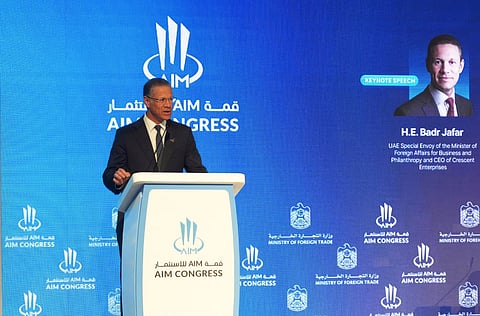
Dubai: South-South trade worth nearly $7 trillion a year is placing the world’s fastest-growing economies at the heart of the emerging global trading system, AIM Congress 2026 heard.
Badr Jafar, Special Envoy of the UAE Minister of Foreign Affairs for Business and Philanthropy, said the disruptions to global shipping this year had demonstrated the importance of building alternative trade routes, partnerships and supply chains before they are needed.
Speaking at the Global Markets Pillar of the 15th edition of the Annual Investment Meeting (AIM) at Dubai World Trade Centre, Jafar said the resilience demonstrated by the UAE and other trading hubs during this year’s disruption was the result of years of investment and cooperation.
“None of that capacity was improvised. It was built years earlier, through corridors that already existed, partnerships that already existed, and trust that already existed. That is the first lesson of this year. The question is no longer: how efficient is Plan A? The question is: how credible is Plan B?” he said.
More resilient
Jafar said governments and businesses must work together to build a more resilient global trading network, noting that the UAE had signed nearly 40 economic partnership agreements in record time, with about half already in force.
“Governments agree with the principles. Business puts them into practice. Government to government, then business to business, node to node,” he said.
He also stressed that technology alone cannot guarantee the resilience of global trade, with trust becoming increasingly important as supply chains become more digitised and reliant on artificial intelligence.
“AI can now reroute a supply chain before a human has finished reading the alert. But the more intelligent trade becomes, the more it depends on something ancient: trust. Data has to be trusted. Standards have to connect. And when the system breaks, people have to pick up the phone,” he said.
Philanthropy
Jafar also challenged what he described as the “myth of the winner who takes all”, arguing that philanthropic capital has an important role to play alongside governments and businesses in developing global trade infrastructure.
“There is a third builder: philanthropic capital. It is patient. It is catalytic. And it asks a different question. Not ‘what is the return?’ but ‘what is missing?’” he said.
He said philanthropic investment could help build the “connective tissue” needed to link markets, communities and infrastructure.
“Government holds the frame. Business lays the cables. Philanthropy strengthens the nodes. That is a whole-of-society architecture that the UAE believes passionately in. And it is the kind that holds,” Jafar said.
He said the UAE had sought to maintain an open and diversified economy through successive global disruptions, including oil shocks, the financial crisis, the pandemic and the turbulence of 2026.
Non-oil foreign trade
The country’s non-oil foreign trade rose 13 per cent in the first half of 2026, he said, adding that the UAE’s strategy was built around providing multiple gateways for global trade.
“That was not luck. It was built long before it was needed. And none of this was built for the UAE alone. A gateway is built for others to pass through it,” he said.
The keynote opened the Global Markets Pillar leaders’ session on trade competitiveness, which brought together government and private-sector leaders from Cambodia, South Africa and Uganda.
AIM Congress 2026, the 15th edition of the Annual Investment Meeting, is being held from September 7 to 9 at Dubai World Trade Centre under the theme “Reshaping Global Prosperity: Unlocking New Investment Pathways Towards a Sustainable and Inclusive Future.”
The event is organised by the AIM Global Foundation in partnership with the UAE Ministry of Foreign Trade. Last year’s edition attracted more than 15,800 participants from 181 countries.


