
How to waterproof and care for leather boots
Make your leather boots last longer with this simple autumn care routine
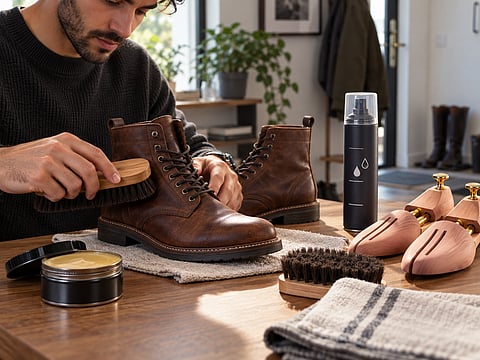
Leather looks solid, but under a microscope it is a network of collagen fibres whose behaviour changes with moisture. The Canadian Conservation Institute notes that leather can gain and lose internal moisture, while direct wetting can make some types swell, stiffen, stain or distort as they dry. That explains why good boot care involves more than making the surface shiny. Cleaning removes abrasive dirt, conditioning or polish helps maintain the finished leather, and a suitable protector reduces the amount of liquid reaching the surface. Autumn is a useful time to do all three, particularly for boots returning from months in storage.
What waterproofing actually does
Waterproofing" is often used loosely in shoe care. A wax, cream or protector can make the upper more water repellent, but it does not turn an ordinary leather boot into fully waterproof footwear. Water can still enter through seams, stitching, the tongue and other parts of the construction.
Leather type matters too. Smooth finished leather, suede and nubuck should not automatically receive the same treatment. The Canadian Conservation Institute points out that resistance to water varies substantially according to tanning and finishing methods. Check the boot maker's care instructions before applying anything, especially on suede, nubuck or pale leather.
For a simple routine, brush away dry dirt first. Apply an appropriate polish or conditioner sparingly to smooth leather and buff it. Add a compatible protector if extra water repellency is wanted. If boots get wet, let them dry naturally rather than placing them beside a strong heat source. Shoe trees can then help the upper retain its intended form.
What to look for
Compatibility matters more than ambitious waterproofing language. Choose care products intended for your particular leather and test creams or sprays on a hidden area first, since treatments can affect colour or finish. A soft horsehair brush is useful because one tool can remove loose surface dirt and buff polish. With protector sprays, follow the manufacturer's distance, drying and ventilation instructions rather than saturating the leather.
Recommended products
Kelly's Neutral Shoe Polish
For smooth finished boots that need routine polishing, this neutral cream is the starting point in this set. The Kelly's Neutral Shoe Polish, manufactured by Fiebing's, in a 1.5oz container. Catalogue information describes a natural wax formulation intended to condition and polish finished, grained and smooth leather. Neutral is useful when you want to maintain several boot colours without keeping a separate polish for each. It should still be patch tested first, particularly on lighter leather. Think of it primarily as leather maintenance and polish, rather than a substitute for a dedicated rain protector.
Zanzike Horsehair Shoe Brush Set
A brush is the least complicated part of the routine and arguably the one worth using most frequently. The following product, a Zanzike two piece set, with a larger horsehair brush and a smaller long handled brush. The specifications list wooden handles and identify the set for shoe and boot care. The larger brush makes sense for sweeping dust from an upper and buffing polish across broad leather panels, while the smaller format gives more control around edges and seams. Keep a brush used for removing dirt separate from one used for final buffing if polish starts building up in the bristles.
Crep Protect Spray
This is the water repellent layer in the routine. Crep Protect says its 200ml spray creates a hydrophobic coating and is suitable for leather, nubuck, suede and canvas. The company instructs users to test for colourfastness, apply from about 20cm away in a well ventilated area, let the coating dry for 10 minutes, then repeat with a second coat. Those instructions are more useful than treating "waterproof" as an absolute promise. On smooth leather boots, apply lightly rather than soaking the surface. Crep itself warns that over application on leather can leave a visible residue.
Allen Edmonds Combination Cedar Shoe Tree
Shoe trees do not waterproof boots, but they address what happens after wear and dampness. Allen Edmonds says its cedar shoe trees support the footwear's original shape while cedar absorbs moisture accumulated inside. The Combination model uses an adjustable split toe design. This makes it a useful final step after brushing and care products have dried. Insert the trees without forcing them into the boot. They are there to support the upper rather than stretch it, particularly around the creases that naturally develop across the forefoot.
Verdict
Good leather care is less about applying large quantities of product than doing the jobs in the right order: remove dirt, maintain smooth leather with a suitable polish, add water repellency where appropriate and let damp footwear dry without aggressive heat. The Crep Protect Spray is the most directly relevant pick for added rain resistance, while the brush and neutral polish form a straightforward maintenance kit. Cedar shoe trees make most sense for boots you intend to keep in regular rotation for years.
Gulf News earns a commission on purchases made through links in this article, at no extra cost to you. Our editorial team selects products independently.


