Scientists detect space ripples from birth of universe nearly 14b years ago
Scientists pick up space-time ripples sent out in the first second of the Big Bang
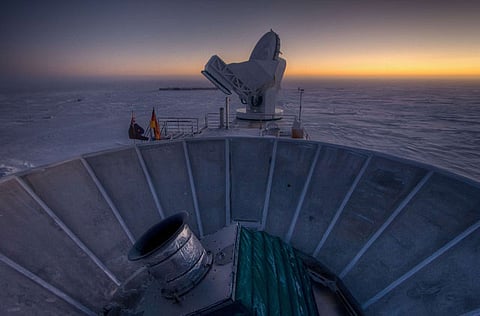
London: Space-time ripples which were sent out in the first second of the Big Bang nearly 14 billion years ago have been picked up by Harvard scientists for the first time. Astrophysicists have been hunting for “primordial gravitational waves” since they were predicted by Albert Einstein’s theory of general relativity in 1916.
After days of rumour and speculation, scientists from the Harvard-Smithsonian Centre announced on Monday they had recorded the first direct evidence of gravitational waves rippling through the infant universe.
“The implications for this detection stagger the mind,” said project leader Jamie Bock. “We are measuring a signal that comes from the dawn of time.”
The universe burst into existence 13.8 billion years ago. Fractions of a second later, space and time were created, expanding exponentially in an episode known as “inflation”. It was believed that inflation should also produce gravitational waves — ripples in space-time which spread throughout the universe.
The signal was found using a specialised telescope called Bicep (Background Imaging of Cosmic Extragalactic Polarisation) at the South Pole, which is the clearest place on Earth for stargazing. It scans the sky at microwave frequencies, where it picks up light energy from slightly after the Big Bang — around 380,000 years later.
The scientists had been searching for tiny ripples in this light which would show it is being slightly stretched by gravitational waves. These cause a distinct twisting pattern known as a “curl” or “b-mode” in the cosmic microwave background radiation.
Dr Joanna Dunkley, a lecturer in astrophysics at Oxford University, said the finding would give the most “direct view” possible of the Big Bang and tell scientists what was happening right at the beginning of the universe.
Meanwhile, Dr Chris Lintott, also an astrophysicist at the University of Oxford, said the finding was the “most significant cosmological discovery in nearly two decades”. “It’s like all our Christmases at once — I doubt many cosmologists will get much sleep tonight,” he said.


