'Mr Shunt' shows a heart for little patients with bloated heads
Hydrocephalus is a congenital problem closely linked to poverty
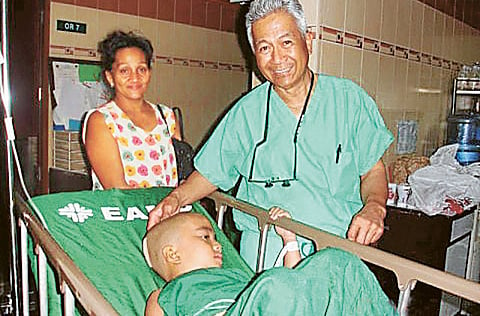
Manila: Seven-month old Rodelio Cadas, the 10th child of farmers in southern Luzon, was born with an oversized head. His mother Myrna and a neighbour managed to collect 3,000 pesos (Dh257) with great difficulty, left their hometown in Mamburao, Occidental Mindoro later on January 29, and arrived at four the following morning at a centre offering free treatment for hydrocephalus in suburban Quezon City.
"We had only 400 pesos left for food. We waited for the clinic to open at eight. By 12 noon, my son was scheduled for operation. But we have to raise money again to come back and stay for more than a week of treatment. We have no place to stay here," Myrna, whose child's over-sized head almost covers her chest as she nurses him, told Gulf News.
Strong support base
"About one out of 1,000 poor children suffer from hydrocephalus in the Philippines," said Dr Manuel Cacdac, a renowned neurosurgeon in the United States since the 70s, who has been operating for free on poor patients through medical missions supported by US-based Filipinos since 2006. He has since expanded his work through the Hydrocephalus Foundation of the Philippines (HFP) which he chairs.
"Our patients call me Mr Hydrocephalus, sometimes Mr Shunt," said Cacdac, 72, in reference to the ailment he is trying to eradicate for free in his country; and to a process called shunting that doctors do in the ventricles of the patient's brain to drain excessive cerebrospinal fluid down to the abdomen.
4 visits each year
An average of more than 10 patients come to see Dr Cacdac daily for diagnosis during the three-week field missions he started conducting four times a year since 2010. "My vision is to have a hydrocephalus centre in Asia. Hydrocephalus is a common congenital and poverty-related problem in Southeast Asia and other Third World countries," said Dr Cacdac, adding that he would need between 40 million pesos to 50 million pesos to get started with his grand plan.
But one of his immediate plans is to rent a place to stay for patients from far-away provinces. "A patient stays three days at the hospital and must be observed a week after the operation. A patient's family must stay more than one week near HFP's office," says Dr Cacdac, in reference to his diagnostics centre on East Avenue in Quezon City.
The fact that US-trained Filipino doctors had taken it on themselves to come home and help poor children with hydrocepahlus mirrors a very big health problem in the Philippines, analysts said. "I was shocked that no other non-government organisation has been doing this kind of assistance," Dr Cacdac says, adding he realised this when he started conducting medical visits along with the 300-strong Society of Philippine Surgeons in America (SPSA) in the Philippines in 2006.
Last year, the United States Internal Revenue granted HFP its 501-C3 incentive, allowing funders to avail commensurate tax deduction. The Philippines Bureau of Internal Revenue however is yet to extend HFP any similar relief.


