Efforts on to bring calm to Karachi
Gilani chairs meeting in port city amid calls for deployment of army
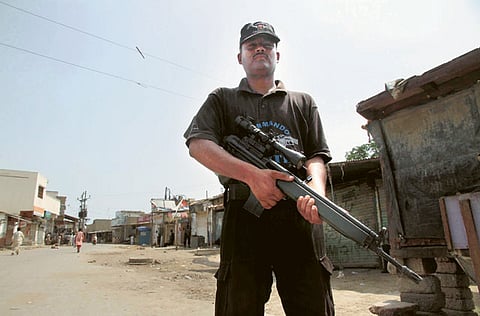
Islamabad: Calls for the deployment of army to stop continuing bloodshed in Karachi, mounted on Monday while Prime Minister Yousuf Raza Gilani chaired an emergency meeting in the port city as nine more people fell prey to the ongoing violence.
Pakistan's Chief Justice Iftikhar Mohammad Chaudhry, responding to a published letter appealing to him to take notice of the unrest in the capital of southern Sindh province and economic hub of the country, asked the electronic media to provide footage on what is widely seen as political-ethnic mayhem.
The chief justice, taking suo moto notice, has converted the letter into a human rights case and proceedings will be held in the coming days, court officials said.
Separately, an advocate filed a petition with the Supreme Court office, pleading for an order to the government to deploy the army in Karachi in view of the failure of the authorities, the police and paramilitary soldiers to control violence in Karachi, which has claimed around 90 lives in six days.
Police said gunmen yesterday raided and killed five employees of the Karachi water supply management in their office while four bodies dumped in gunny bags were found in different parts of the city.
Gilani met Sindh Governor Dr Ishratul Ebad and Chief Minister Syed Qaim Ali Shah at the Governor's House in Karachi and discussed the situation and the measures taken by the provincial government. Federal Interior Minister Rehman Malek was also present in the meeting.
The meeting reviewed the overall situation in Karachi and discussed various proposals to bring normalcy to the city, officails said.
The prime minister directed the provincial government to take indiscriminate action against the culprits and bring them to justice. He said all possible measures should be taken to protect the life and property of the people and apprehend law breakers.
He said the Pakistan People's Party (PPP), Muttahida Qaumi Movement (MQM), the Awami National Party and other stakeholders should be taken on board to jointly devise a workable strategy to improve the situation in Karachi.
Out of control
Representatives of the business and trade community were to meet the prime minister later in the day and they said they would press for the use of army to restore order.
Siraj Qasim, a leader of the Karachi Chambers of Commerce and Industry, said the situation had apparently gone out of control of the government and the law enforcing agencies.
"The government has powers to call the army and they must do so in view of the deteriorating situation," he told a private television channel. "If there is political will and sincerity, the bloodletting can be stopped in 24 hours," he added.
Khalid Tawab, vice-president of the national federation of chambers of commerce and industry, said it was imperative to act resolutely and employ all means including the army deployment to pull the country's most important city from the brink of the precipice.
The government was apparently reluctant to assign the law and order task to the army until such a course becomes unavoidable.
Army deployment
Before leaving for Karachi, Gilani told the media that it was for the provincial government to decide whether army deployment was needed. He however pointed that military operations were never a permanent solution to problems.
The Karachi unrest has increased pressure on the Pakistan People's Party government already buffeted by other challenges including unabated terrorism, high inflation, growing unemployment, energy crisis and insurgency in southwestern Balochistan province.
The violence in Karachi also appears to have delayed a patch-up between the ruling PPP and MQM, the second largest party in Sindh and the latter's return to the fold of the government.
The main opposition is demanding fresh elections, though the government's five-year term is due to expire in 2013.
The demand was dismissed by Gilani after the opposition leader former prime minister Nawaz Sharif said last week that snap polls were the only option to pull the country out of the crisis.


