Time running out in Donetsk
Pro-Russian activists take over key buildings to force a Crimea-style referendum and reunification with Moscow
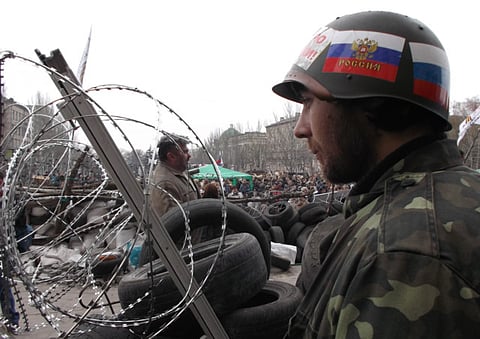
Donetsk, Ukraine: The clock is ticking down here and in the nearby city of Lugansk where hundreds of pro-Russian activists have taken control of key administrative buildings in an attempt to force a Crimea-style referendum and reunification with Moscow.
Acting President Oleksandr Turchynov — in power since the February 22 ouster of a pro-Russian leader and still proclaimed illegitimate by the Kremlin — is urging the demonstrators to dismantle their barricades and walk away without being charged.
But his olive branch was met with derision by the protesters Thursday afternoon — vowing not to leave their positions in defiance of an ultimatum from the Kiev government to do so by Friday morning.
“We do not listen to what the Ukrainian government says,” student Vitali Eyanovich told Gulf News as he stood guard with a baseball bat behind a tyre and razor wire barricade outside Donetsk City Hall.
“This is the people’s republic of Dom Bass and we belong in our motherland, which is Russia.”
The pro-Russian activists want a Crimea-style referendum on rejoining the Russian Federation, similar to an arrangement of the former Soviet Union.
The Kiev parliament’s minority pro-Russian factions have been pushing a bill to amnesty the separatists that the Western-leaning majority has refused to support.
But Turchynov announced that he preferred a peaceful end to the standoff and was willing to guarantee the militants’ safety if they walked out of the buildings quickly.
“If people lay down their arms and free the administration buildings, we do not need to adopt any amnesty laws,” said Turchynov.
“We guarantee that we will not launch any criminal proceedings against them. I am ready to formalise this in a presidential decree,” he promised.
“We can solve this problem today.”
At a separatist rally Thursday morning — in a park where a statue of Lenin and local Ukrainian heroes of the Soviet Union’s Second World War are honoured — they called on President Vladimir Putin to push the tens of thousands of troops now massed along Ukraine’s border into its eastern industrial heartland.
Many in Ukraine’s southeast — a region with a much longer history of Russian control that stretches back to tsarist times — are wary of the more nationalist leaders who rose to power in Kiev and have been looking to Putin for help.
The negotiations here — a blue-collar coal mining region where ousted president Viktor Yanukovych made his political career — have involved some of Ukraine’s most powerful security officials as well as its richest tycoon.
Officials said businessman Rinat Akhmetov and the region’s governor have both joined Kiev’s efforts to tone down the militants’ demands.
“They are working on a peaceful solution, and this fills us with optimism,” said First Deputy Prime Minister Vitaliy Yarema.
Akhmetov — his wealth estimated by Forbes magazine at $11.4 billion (Dh40 billion) — was a key financial backer of Yanukovych who is thought to wield tremendous influence throughout Donetsk.
But he is believed to be trying to establish closer relations with the new pro-Western leaders who are likely to prevail in snap May 25 presidential polls.
Both Washington and EU nations have accused the Kremlin of orchestrating the unrest in the east in order to have an excuse to invade the region — a charge stiffly denied by Moscow.
But a seeming breakthrough in the worst East-West crisis since the Cold War era emerged on Tuesday when US and EU diplomats managed to convince both Moscow and Kiev to come together for four-way negotiations that one source in Brussels said should be held in Vienna on April 17.
At stake are not only the vast ex-Soviet state’s territorial integrity and political future but also the fate of the West’s relations with Moscow and all the repercussions this carries for global security in the coming years.
Putin signalled on Wednesday that he expected the talks to follow his idea of turning Ukraine into a loose federation whose eastern regions could establish their own diplomatic and trade relations with Russia — a proposal rejected by Kiev outright.
“I hope that the initiative of Russian foreign ministry on adjusting the situation and changing it for the better will have consequences, and that the outcome will be positive,” Putin told a televised government meeting.
“At the very least, I hope that the acting (leaders) will not do anything that cannot be fixed later,” Putin added without specifying what kind of mistakes he had in mind.
But a top US official said Washington was not setting the bar too high for the negotiations even if it did welcome the opportunity to have direct talks.
“I have to say that we don’t have high expectations for these talks but we do believe it is very important to keep that diplomatic door open and will see what they bring,” US Assistant Secretary of State Victoria Nuland said in Washington.


