'People are shivering in the cold'
Daylight reveals havoc wreaked by one of the worst disasters in nation's history
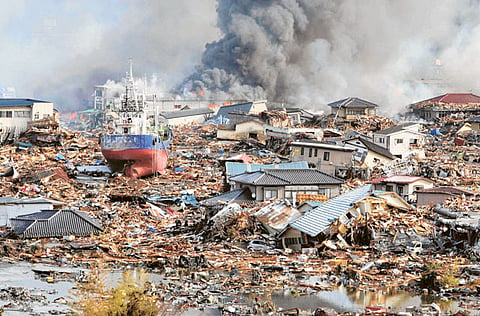
Sendai: Miles from the ocean's edge, weary, mud-spattered survivors wandered streets strewn with fallen trees, crumpled cars, even small airplanes. Relics of lives now destroyed were everywhere — half a piano, a textbook, a soiled red sleeping bag.
Yesterday, one day after a massive tsunami tore through Sendai, residents surveyed the devastation that has laid waste to whole sections of the northern port of one million people, 128 kilometres from the epicentre of the 8.9-magnitude earthquake that set off one of the worst disasters in Japan's history.
Rescue workers plied boats through murky waters around flooded structures, nosing their way through a sea of detritus, while smoke from at least one large fire billowed in the distance. Power and phone reception was cut, while hundreds of people lined up outside the few still-operating supermarkets for basic necessities. The gas stations on streets not covered with water were swamped with people waiting to fill their cars.
A convenience store five kilometres from the shore was open for business yesterday, though there was no power and the floors were covered with a thick layer of grime.
"The flood came in from behind the store and swept around both sides," said shop owner Wakio Fushima. "Cars were flowing right by."
With most other stores closed, a steady flow of customers stocked up on drinks and instant noodles, knowing it would be a long time before life returns to anything like normal.
Recalling the horror
Some recalled how they cheated death as the massive waves swept some 10 kilometres inland. An unknown number of others perished.
Police said they found 200 to 300 bodies washed up on nearby beaches, but authorities are only now getting a look at the extent of the devastation in Sendai and along the coast.
Rail operators lost contact with four trains running on coastal lines Friday and still had not found them yesterday afternoon, Kyodo News agency reported. The East Japan Railway Co said it did not know how many people were aboard.
To the south in Iwaki city, Keiko Komaki and her daughter were on their way to an evacuation centre.
"We are still getting a lot of aftershocks," she said. "It's very frightening. People are panicking, shivering in the cold."
Many area residents spent the night outdoors, or wandering debris-strewn streets, unable to return to homes damaged or destroyed by the quake or tsunami. Those who did find a place to rest for the night awoke to scenes of utter devastation. The city's Wakabayashi district, which runs down to the sea, remained a swampy wasteland with murky, waist-high water.
Grief
Most houses were completely flattened, as if a giant bulldozer had swept through.
Grief-stricken residents searched for their former homes, but as they stood in the dark water looking for some sort of landmark, many couldn't even tell where they were. Amid the scattered, splintered remnants of wood, metal and glass, occasionally there was something recognisable — a chair, a tire or a beer cooler.
Workers at an electronics store gave away batteries, flashlights and phone chargers. Several dozen people waited patiently outside as a steady stream of aftershocks shook the city. From a distance, the store appeared to have survived the devastation intact. But a closer look revealed windows smashed out and walls slightly buckled.
Inside was chaos. The ceiling of the second floor had collapsed, and large TVs, air conditioners and other products lay smashed and strewn about the aisles.


