Funding Putin's arms drive will be a major problem, sceptics say
€600b programme expected to benefit hobbled private sector
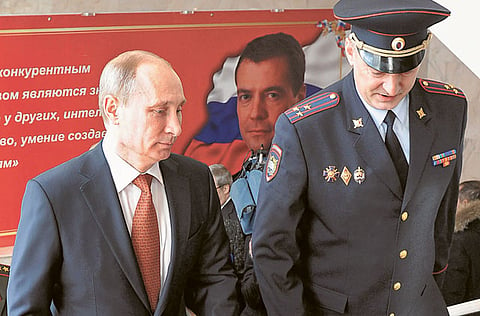
Bangkok The commitment of Russia's Prime Minister Vladimir Putin to spend up to €600 billion (Dh2.92 trillion) on armament has brought a lot of critics into the open. Many of them are questioning the benefits for the Russian economy.
It appears to be a fresh step for an international arms race, but what Putin said on Monday is more or less a summary of proposals that were already broached last year.
The cost to purchase 400 intercontinental missiles, 600 fighter jets, 2,300 tanks, and 20 submarines, among others, would be immense, critics say, and it is completely unclear how Russia is going to fund the plans.
"Funding is going to be a major problem," says Alexej Makarkin, an expert at the Moscow-based Centre for Political Technologies. The planned expenses would eat up 40 per cent of the Russian gross domestic product over ten years, he argues. This was reportedly also the cause for former Russian Finance Minister Alexej Kurdin leaving the government last year.
Five-day war
The money, Makarkin said, is hard to come by, and it would have to be reallocated from state funds for education and infrastructure, which would be a major dent for Russia's societal development.
However, some Russian newspapers are supporting Putin in his plan to arm Russia to the teeth. Rossiskaja Gazeta wrote that the Russian Army has been neglected by the government since the 1990s, while other countries continued their armament programmes — a fact that had led to weaknesses that became obvious during the five-day war against Georgia in 2008.
Russia had missed out on developments in warfare, and did not modernise. All this would cause a strain, which as such is not even related to possible threats from Georgia or Iran, the paper said. Dimitri Wassilev, an expert related to the Austrian-Russian Friendship Society, said that Putin obviously wants to revive the heyday of the Soviet Army.
The related military-economic complex was the driver for the entire Russian economy and the development of new technologies, which eventually led to such epochal developments as the supersonic Tupolev and nuclear submarines.
However, Russia's privatised economy is not diversified enough and a purchasing programme of that scale could benefit the entire system, he said.
The country needed structural reforms rather than a cash injection of that scale to modernise it politically, economically, and to reform its societal structures.


