Black dust envelops Bangkok but life goes on
Deputy Managing Editor Mick O'Reilly takes a last look at Thailand before leaving the chaos-stricken country
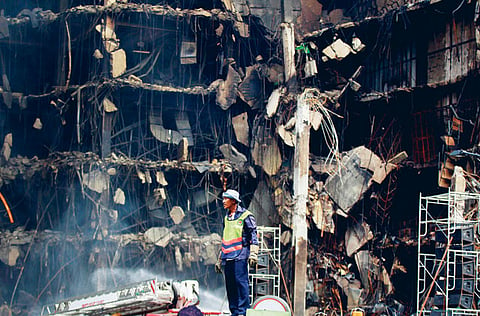
Bangkok: There is a fine black dust covering everything in this city of ten million people. It gets in your eyes, your eyes and you can't help but inhale it.
Outside an Egyptian restaurant in Bangkok's Arab district, some workers were busy throwing buckets of water over the cobblestones and were working up a sweat brushing the dirty water down a drain.
It's lunchtime, but only one man, a beer-bellied tattooed Briton is drinking and smoking shisha. He's oblivious to this fine dust -- the only thing in his mind's eye are the flirtacious Thai girls.
Read special coverage of Thailand crisis
At a street corner, some tuktuk drivers are playing dice for money and are quick to underbid each other for the few foreign fares still available.
Further down Nana street, the shops and stalls have their trinkets and t-shirts on display. At Paul's Tailors, where you can get a handmade suit in a day for 3000 baht, the measuring tapes hang limp around the necks of the five assistants.
On the street, few locals are stopping at the street stalls selling all types of barbeque food and noodles. There is, after all, a fine black dust most likely flavouring that street food.
The fine dust is actually rubber particles that have come to rest after rising in columns of dense acrid smoke during days of street protests. The anti-government Red Shirt protesters quickly lit those tyre barricades on the first sign of trouble.
The protesters were well organised and had though out their defences well.
Beside every tyre barricade were cooking gas cyliners with rubber hoses attached, or industrial gas cylinders the type welders use.
At the first sign of a military advance, the makeshift flame thowers were lit and used to thenquickly set the fires. The burning tyres provided a smokescreen through which the army couldn't easily identify targets.
The petrol bombs were cleverly thought out too. Some palm sugar was added to the petrol mix, a homemade napalm as it were, ensuring the flames would stick and burn more fiercely to whatever they hit.
And the quick-burning tyres were also placed at the wooden poles that carry power cables around the city: flames go up, cables come downn power goes out.
On Friday, Royal Thai Police recovered 22 million baht worth of gold and jewellery from a car parked near a Bhuddist temple where some Red Shirts had sought sanctuary at the height of Wednesday's military assault.
The jewellery had been looted from a store in the Centre Point Shopping Centre before the mall was deliberately set ablaze. It was Thailand's largest shopping centre. Not any more. It is going to be rebuilt from the ground up. It was, afterall, burned to the ground on Wednesday.
On that day -- I like to refer to it as Ash Wednesday -- as I cowered behind a wall with bullets whizzing over my head from both military and Red Shirts, one teen offered me a homemade hand grenade.
I politely declined with a "No thanks," and was tempted to sarcastically add: "I've just had one." I refrained. He ran to the end of the alley and threw it up the burning street towards the troops.
On Friday evening as I travelled to the airport, I went through four separate military checkpoints. No there were no looted jewels or homemade hand grenades in my luggage. But there was that black dust on my computer bag and on my suitcase and in my eyes. Al least I get to leave.
I also won't have to worry about any clouds of volcanic ash as I go west to Dubai.
It's going to take Thailand a very long time to recover from their own eruptive clouds of fine black dust. If ever.


