India parliament passes anti-corruption bill
Nation waited for 46 years for a stringent anti-corruption legislation
New Delhi: India yesterday took a giant step towards combating rampant corruption with the Lok Sabha passing an anti-corruption bill.
The Lokpal Bill, as the instrument is known, was passed by voice vote amid commotion created by some lawmakers opposed to a different bill, which seeks to divide Andhra Pradesh and create the new state of Telangana.
The Rajya Sabha had passed the Lokpal Bill on Tuesday.
The bill provides for appointment of a Lokpal (ombudsman) by a four member committee comprising the prime minister, leader of opposition, chief justice of India and one of his nominees. The Lokpal will handle all corruption-related allegations, which will be investigated by the Central Bureau of Investigation. Any officer investigating a charge cannot be transferred without prior approval of the Lokpal.
All ministers and senior public servants are covered by the bill, and even the prime minister falls under the scope of the law.
Arch-rivals the Congress party and Bharatiya Janata Party (BJP) closed ranks to pave the way for fulfilling the long-awaited anti-corruption bill, which was first brought before Parliament 46 years ago by the then prime minister Indira Gandhi.
Except for the Samajwadi Party, all parties supported the bill and concluded the process of introducing, debating and voting on the bill within an hour, although four hours had been set aside for debate.
Both Houses of Parliament were later adjourned, without setting a date for the next meeting, two days ahead of the scheduled end of the winter session. This also happens to be the last legislative session of the incumbent Manmohan Singh government, considering the next budget session would be held just to pass vote on account, leaving presentation of the next budget to the new government following April-May general elections.
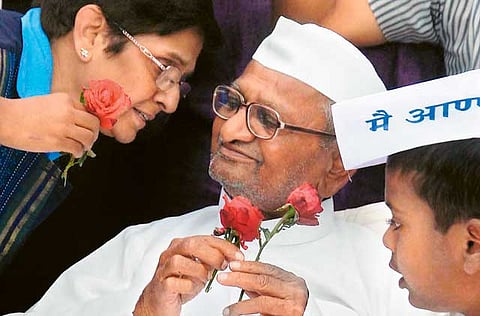
The Lokpal Bill came into focus when anti-corruption crusader Anna Hazare started a series of hunger strikes from August 2011.
While the Lok Sabha had passed the bill in December that year, it took two years before the Rajya Sabha put its stamp of approval after several amendments, which required ratification of the amended bill by the Lok Sabha all over again.
The bill will now be sent to President Pranab Mukherjee for his signature before it becomes law.
Hazare, who had been on an indefinite fast, in his hometown Ralegan Siddhi of Maharashtra, to demand the passage of the Lokpal Bill, broke his fast after receiving the news.
While Hazare thanked all lawmakers barring those of the Samajwadi Party for passing the bill, the usual rat race to take credit for the success started right inside the Lok Sabha.
Leader of opposition Sushma Swaraj credited Hazare and the people for the bill’s passage, while the ruling Congress party vice-president Rahul Gandhi thanked his party’s government, saying the Congress party was serious about fighting corruption since the beginning. Gandhi referred to the Right To Information Act in this connection.
“People are lining up to take credit, but there is an old man who keeps fasting for the bill and appeals to our collective conscience. And then the people of this country deserve credit,” Swaraj said.
Rahul Gandhi on the other hand reminded lawmakers about Congress party’s continued fight against corruption.
“It is our responsibility to complete our unfinished fight against corruption … The Lokpal Bill is part of the UPA government’s comprehensive anti-graft framework,” Gandhi said.
Samajwadi Party chief Mulayam Singh Yadav described the bill as dangerous and said that it will hamper progress and development considering bureaucrats would now think twice before singing any file.


