Syrian forces making house-to-house raids across nation - activist
A rights activist says Syrian security forces are conducting house-to-house raids across the country
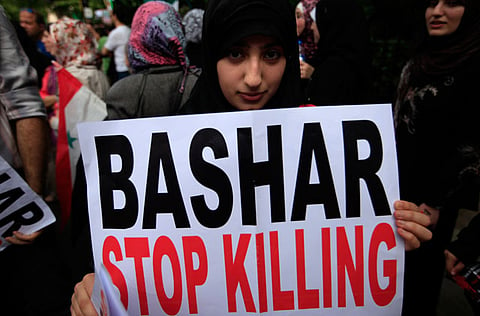
Beirut: A rights activist says Syrian security forces are conducting house-to-house raids across the country, detaining hundreds of people as part of a widening crackdown on anti-government protests.
Rami Abdul Rahman, director of the Syrian Observatory for Human Rights, says the arrests are zeroing in on the demonstrations' organisers and participants.
Abdul Rahman said Monday's raids were focused in the central city of Homs, the coastal city of Banias, some suburbs of the capital Damascus and villages around the southern flashpoint city of Daraa.
The continued crackdown suggests that Assad's regime is determined to crush the uprising by force and intimidation, despite rapidly escalating international outrage and a death toll that has topped 630 civilians since the unrest began in mid-March, according to rights groups.
Overnight on Sunday, President Bashar Al Assad sent tanks deep into Syria's third city Homs, escalating a military campaign to crush a seven-week-old uprising against his autocratic rule.
Syrians demanding political freedom and an end to corruption have held weeks of what they say are peaceful demonstrations in the face of government repression, despite a civilian death toll that has reached 800, according to the Syrian human rights organisation Sawasiah.
On Sunday, Homs residents told Reuters they heard machinegun fire and shelling as troops made their first incursion into residential areas of the city of one million people, 165km north of Damascus.
At least one person, a 12-year-old child, was killed when tanks and troops charged into the Bab Sebaa, Bab Amro and Tal al-Sour districts of Homs overnight, according to the Syrian Observatory for Human Rights.
"The areas have been under total siege since yesterday. There is a total blackout on the numbers of dead and injured, Telecommunications and electricity are repeatedly being cut in those districts," the Observatory said in a statement.
Elsewhere, a witness said security forces killed at least two unarmed demonstrators on Sunday when they fired on a night rally in the eastern city of Deir Al Zor.
Assad, who has maintained the autocratic political system inherited from his father, began by making vague promises of reforms, but when that failed to stop the protests, he made clear he will not tolerate dissent or risk losing the tight control his family has had over Syria for the past 41 years.
The pro-democracy upheaval that began in Deraa on March 18, inspired by similar revolts across the Arab world, intensified on Friday across Hauran, an agricultural belt bordering Jordan to the south and the Israeli-occupied Golan Heights to the west.
In the south, tanks swept into several towns on Sunday.
A man was killed when security forces smashed their way into his home in the southern town of Tafas, a rights campaigner in the region said.
Hardline model
"Two models have emerged during this Arab democratic revolution: Egypt and Tunisia, where there is an established concept of the state and of the army as an institution of the state ... and the Libyan and Yemeni model," Jordanian statesman Adnan Abu Oudeh told Reuters.
"Syria belongs to the latter," said Abu Oudeh, who is a board member of the International Crisis Group, an independent conflict resolution group.
An opposition figure said that even if the half a million members of Syria's army and other security forces obeyed Assad - they are led by officers of the Alawite minority to which Assad belongs - the 45-year-old president would not be able to crush the growing popular hostility to his rule.
Shocks absorbed
"The shocks of the military campaign are being absorbed. We have seen that as soon as the army withdraws or lessens it presence in one area to crush people elsewhere, protests erupt in the area the forces had left," the opposition figure said.
"Assad is using Israeli tactics, but will not be able to occupy all of Syria with his loyalists," he added.
Protesters are demanding political freedoms, an end to corruption and the departure of Assad, and deny his assertion that they are part of a foreign conspiracy determined to cause sectarian strife.
Armed gang
Syrian authorities have blamed the nearly two months of protests on "armed terrorist groups" they say are operating in Daraa, Banias, Homs and other parts of the country.
The official state news agency said an "armed gang", a term used of opponents of the government, had ambushed a bus near Homs and shot dead 10 civilian workers returning from Lebanon.
Until the uprising began, Assad had been emerging from a period of isolation by the West for defying the United States over Iraq and reinforcing its informal anti-Israel alliance with Iran -- a link that had worried Syria's Sunni Muslim majority.
An army attack on Sunni areas in the coastal city of Banias this weekend raised tension between Sunnis and Alawites. On Saturday soldiers shot dead four women taking part in a small all-women demonstration near the city, rights campaigners said.
The West had been working to end Assad's international isolation to wean Damascus off its Iranian alliance and encourage peace moves with Israel, but his crackdown on dissent has put that rapprochement on hold.


