Hope floats for leaders at Tehran summit
Syria and Iran look to expand anti-Israeli bloc in the region as per latest talks
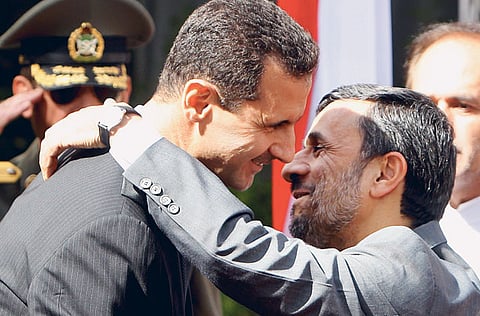
Damascus: The leaders of Iran and Syria at a summit in Tehran on Saturday expressed hope of expanding the anti-Israeli bloc in the region, the Iranian presidential office said in a statement.
Syrian President Bashar Al Assad started talks with his Iranian counterpart Mahmoud Ahmadinejad upon his arrival in Tehran for the one-day visit.
"The strengthening of the [anti-Israeli] resistance movement will encourage other countries to join this bloc which then would eventually lead towards stabilising regional peace," the statement quoted Ahmadinejad as saying in the talks with Al Assad.
According to the statement, Al Assad also said the momentum of Tehran-Damascus ties could strengthen resistance groups against Israel.
The agenda centred around regional developments in Lebanon, Iraq and Palestine according to media reports. The visit was also aimed at reassuring Iranian leaders that the alliance between the two countries is solid despite Syria's improved relations with the United States.
The visit comes less than a week after US Secretary of State Hillary Clinton met Syrian Foreign Minister Walid Al Mua'allem in New York.
Al Assad had earlier met George Mitchell, President Barack Obama's Middle East envoy, who is now trying to save Palestinian-Israeli peace talks from collapse.
One main objective of the US rapprochement toward Damascus, which began after Obama took power last year, is to drive a wedge between Syria's secular ruling hierarchy and Iran's religious Shiite rulers, analysts say.
The US also wants Syria to distance itself from Iranian-backed Lebanese Shiite group Hezbollah.
A US official said after the Clinton-Mua'allem meeting that Syria was "very interested" in renewing peace talks with Israel as part of a Middle East settlement pursued by Washington.
But Washington, the official said, was concerned about "Syria's activities inside Lebanon" and its relationship with Hezbollah, which Washington accuses Damascus of arming with the help of Iran in contravention of a United Nations resolution.
Thabet Salem, a Syrian journalist and political commentator, said talks between Syria and Washington will worry Iran less if Iranian-US ties become less hostile.
"The Syrians have made it clear that Damascus' ties with the United States are theirs only to handle," Salem told Reuters.
Proxy force
While Iran has strongly criticised the US-sponsored peace talks, Syria has kept its objections low key.
Syria has also taken a softer stance toward Palestinian President Mahmoud Abbas in the last several months and is hosting a second round of talks between Hamas and Abbas' Fatah faction this month to try to narrow a schism between the two groups.
But Hezbollah remains the lynch pin of Syria's alliance with Iran, having acted as a formidable proxy force in conflicts with Israel — most recently in a 2006 war — and strengthening the strategic position of its Syrian and Iranian patrons.
A Damascus-based diplomat said neither Syria nor Iran want to see Hezbollah compromised by a domestic row over an international tribunal investigating the 2005 assassination of Lebanon's former prime minister Rafik Hariri.
Hezbollah officials said the tribunal could indict some of the group's members, tainting its credibility, and hinted that an indictment could plunge Lebanon into renewed instability.
"Syria does not want Lebanon to go haywire and Iran does not want Hezbollah weakened by domestic conflicts as a force against Israel," the diplomat told Reuters.
The alliance with Tehran dates to the 1979 Islamic Revolution, when Syria cultivated Iranian-backed clerics in neighbouring Lebanon and was the only Arab country that supported Iran in its 1980-1988 war with Iraq.
Iraq has been the focus of the talks between Al Assad and Ahmadinejad on the two trips the Iranian president has made to Syria this year.


