Rafah decision signals change of heart in Egypt
Clandestine imports became the norm in enclave 1.4m Gaza residents' isolation may ease as blockade ends
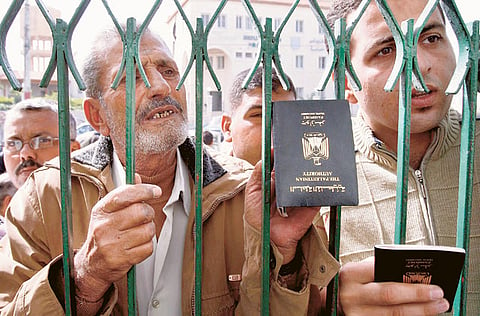
Cairo: Egypt's decision on Wednesday to end its blockade of Gaza by opening the only crossing to the Hamas-ruled Palestinian territory this weekend could ease the isolation of 1.4 million Palestinians there. It also puts the new Egyptian regime at odds with Israel, which insists on careful monitoring of people and goods entering Gaza for security reasons.
The Rafah crossing will be open permanently starting tomorrow, Egypt's official Middle East News Agency (Mena) announced. That would provide Gaza residents their first open border to the world in four years, since Egypt and Israel slammed their crossings shut after the Hamas resistance movement overran the Gaza Strip in 2007.
During the closure, Egypt sometimes opened its border to allow Palestinians through for special reasons such as education or medical treatment. But with Israel severely restricting movement of Palestinians through its Erez crossing in northern Gaza, residents there were virtual prisoners.
Old rules to apply
Mena's statement said the old rules will be reinstated, allowing Palestinians with passports to cross into Egypt every day from 9am to 9pm except for Fridays and holidays.
Entry into Gaza was more complicated. Palestinians ran their side of the crossing. European monitors had a role at the crossing, and they have been waiting to resume that function. Also, Israel was supposed to have a monitoring role from afar, theoretically to stop weapons and Hamas fighters from entering Gaza.
Mohammad Awad, the Hamas' minister of foreign affairs, said he "highly appreciates the decision by the Egyptian brothers to ease the process of travel at Rafah terminal. This reflects the deep relation between us and Egypt, and it will contribute to ease the lives of the Palestinians in Gaza."
The military council running Egypt until parliamentary and presidential elections is less concerned about its relations with Israel and has shown more interest in the Palestinians.
Mena said the decision to open the Rafah crossing was part of efforts "to end the status of the Palestinian division and achieve national reconciliation".
Egypt's foreign minister Nabeel Al Araby told the Arabic satellite channel Al Jazeera last month that the closure of the Rafah crossing was about to end, calling the decision to close it "a disgusting matter".
Egypt was the first Arab nation to sign a peace treaty with Israel in 1979. There have been polls that indicate many Egyptians would favour cancelling the treaty.
Cairo (AP) Besides trapping more than a million Palestinians in Gaza, the Rafah border closure has been largely ineffective.
Gazans have circumvented the blockade by operating hundreds of smuggling tunnels under the 15-kilometre Gaza-Egypt border. The tunnels have been used to bring in all manner of products, as well as people. Israel charges that Hamas has used the tunnels to import weapons, including rockets that can reach main population centres in Israel.
The tunnel industry is a semi-official Gaza enterprise, with Hamas collecting taxes on goods smuggled in.
Israel cut back on its restrictions following world outcry over its violent interception of a humanitarian aid flotilla heading for Gaza on May 31, 2010, when nine pro-Palestinian activists were killed.
Israel has complained often about Egypt's inability to stop the smuggling.
In recent months, Palestinian resistance fighters in Gaza have fired rockets at Israeli cities showing that they don't want for firepower.


