US commanders forced to rethink Iraq pullout pace
Increase in violence, political instability fuel decision
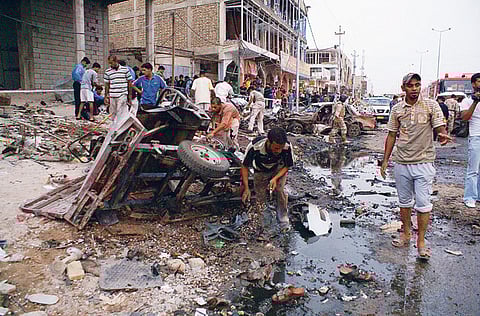
Baghdad: Worries over increased violence fuelled by Iraq's political instability have forced US commanders to reconsider the pace of a major pullout this summer without overstepping a deadline to cut the military's presence by nearly half by the end of August.
More than two months after parliamentary elections, the next government has still not been formed, and militants aiming to exploit the void have carried out attacks like Monday's bombings and shootings that killed at least 119 people, in the country's bloodiest day of 2010.
The insurgent threat has prompted military officials to figure how to keep as many troops on the ground, for as long as possible, and still withdraw all but 50,000 US troops by August 31, as ordered last year by President Barack Obama.
In Baghdad and Washington, US officials say they remain committed to the deadline, which would only be pushed back by Obama to deal with a severe worsening of Iraq's security.
But the start of what the top US commander in Iraq, Army Gen Ray Odierno, called the withdrawal "waterfall" — that is, the sending home large numbers of troops in a very swift period over the summer — could be effected.
In a January interview with the Associated Press, Odierno said he hoped to start withdrawing as many as a monthly average of 12,500 troops, starting in May, to meet the August deadline.
At the time, there were 96,000 US troops in the country. As of last week, that number was at 92,000, meaning an average of 10,500 a month would have to be pulled out.
Ongoing concerns
But three US officials in Baghdad and a senior Pentagon official said that the "waterfall" is now expected to begin in June at the earliest, instead of May. All said that was due to ongoing concerns about whether the political impasse would lead to violence, and spoke on condition of anonymity to discuss the process more candidly.
"From a military perspective, the best way for us to maintain security is to hold as many forces on the ground until we need to redeploy them," one of the senior officials in Baghdad said. "It's really prudent, given the political conditions are unsettled, for (Odierno) to wait as long as he can."
At the Pentagon, "there's been a renewed focus on Iraq lately," the senior military official there said. He said all options were being considered, including later delays, adding that "we need to get out in an appropriate way... not completely tied to a timeline."


