Iraq forms ‘inclusive’ government
Hoshyar Zebari and Saleh Mutlak both appointed deputy prime ministers
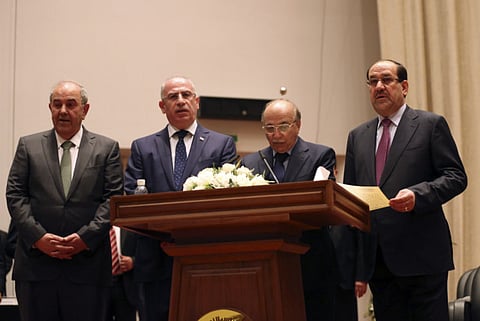
Baghdad: Iraq’s parliament approved a new government headed by Haider Al Abadi as prime minister on Monday night, in a bid to rescue Iraq from collapse, with sectarianism and Arab-Kurdish tensions on the rise.
Al Abadi included members of Iraq’s Shiite majority and its Kurdish and Sunni minorities in his cabinet as he started his uphill task to unify the country after this summer’s devastating loss of territory across northern Iraq to Islamic State of Iraq and the Levant (Isil) militants.
Adel Abdul Mehdi from the Islamic Supreme Council of Iraq was named oil minister while Ebrahim Jafaari, a former premier, was named foreign minister. Rowsch Shaways, a Kurd, was named finance minister. No interior or defence minister was named but Al Abadi pledged to do so within a week, bringing the cabinet to 37 posts.
Al Abadi’s deputy prime ministers are Hoshyar Zebari, a Kurd and Iraq’s only post-Saddam Hussain foreign minister, Saleh Mutlaq, a secular Sunni who served in the same position in the last government, and Baha Arraji, a Shiite Islamist and former lawmaker.
The parliament approved the ceremonial posts of vice-presidents — the last prime minister Nouri Al Maliki, like Al Abadi from the Shiite Islamist Dawa party; former premier Eyad Allawi, a secular Shiite; and the last parliament speaker Usama Al Nujaifi. The three have been seen as political rivals.
Al Abadi looked ahead to unifying the country and defeating Isil, whose offensive this summer across northern Iraq has threatened to tear his nation apart along sectarian lines.
Al Abadi vowed to “allow all people in Iraq to participate in liberating the cities and provinces which have been taken over by terrorist groups.. and to bring back security and stability”. The prime minister warned: “Any armed formation outside the authority of the state is banned.”
However, Al Abadi was careful in referencing the sensibilities of his Shiite majority sect, which feels it is fighting for its life against Isil.
Al Abadi saluted the network of Shiite militias and ordinary citizens, called volunteers, who mobilised this summer to stop Isil militants from marching on Baghdad. The groups have become controversial, with Sunni political figures and tribal leaders accusing them of killing ordinary Sunni citizens.
Looking to the future, Al Abadi proposed that volunteers should be incorporated into “a national guard organisation”.
He vowed to rebuild the Iraqi army, which nearly collapsed this summer in the face of Isil’s march across northern Iraq. And he promised to work to improve Baghdad’s thorny relationship with Iraqi Kurdistan. He also said he would push a programme of decentralisation.
Until the last moment, it was not clear whether Iraq’s Kurdish bloc would participate. Its senior leadership retreated to the Kurdish region for a final decision. The main sticking point was the Kurdistan Regional Government’s (KRG) budget.
This year, Baghdad stopped paying for the KRG’s civil servants’ salaries in protest against the Kurds exporting oil to Turkey independently. The Kurdish delegation arrived late to the parliament session on Monday but decided to give the new government three months to sort their disputes with Baghdad.


