Egyptians nostalgic about Nasser's rule
Many praise his educational and land reforms
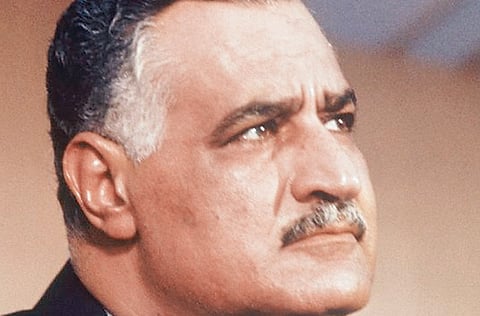
Cairo: Ahmad Masoud, a 55-year-old engineer, is particularly grateful to Jamal Abdul Nasser, Egypt's president who died on September 28, 1970. "Had it not been for the free education which Nasser made a constitutional right, I would not have been an engineer," Masoud said.
He added that he is the son of a simple peasant, who also benefited from Nasser's agrarian reform plan, which redistributed agricultural land taken from feudal lords to farmers.
"Nasser must be turning in his grave seeing that most of his efforts for effecting social justice in Egypt have been undermined," Masoud, a father of three, told Gulf News.
"The bulk of my salary now is swallowed up by spending on my children's education, which has stopped being free. In addition, the public sector companies, which were created under Nasser, have mostly been sold off."
Masoud is one of millions of Egyptians who fondly remember Nasser because "he was the advocate of the poor".
Nasser, who was a leading member of the Free Officers' Movement that toppled the monarchy in Egypt in 1952, is also eulogised as the proponent of Arab nationalism.
Image of Africa
"Nasser changed the image of Africa and the Arab world," said Mustafa Hassan, a commentator in the semi-official newspaper Al Akhbar, referring to Nasser's support for independence of many Arab and African countries from colonial powers.
"Nasser, moreover, gave a top priority to social justice and affirmed the state's responsibility for combating poverty. He was known for integrity. So his rule was not tarnished by corruption," he added.
Nasser, who ruled Egypt from 1954 to 1970, soared to prominence at home and in the outside world during the 1956 Suez Crisis following his decision to nationalise the Suez Canal so as to finance the construction of the High Dam in Aswan in southern Egypt. He survived a tripartite war by Britain, France and Israel, which, ironically, boosted his popularity in Egypt and other Arab countries.
Still, 40 years after his death, Nasser's policies continue to generate controversy.
"Instead of focusing on promoting national development, he was so obsessed with leadership dreams that he plunged the Egyptian army into military adventures in the Arab nation and Africa," said Helmy Saleh, a political science professor.
"In addition, he depended on people whom he trusted but who had no experience in the army. Hence, the ignoble defeat suffered by the Egyptian army at the hands of Israel in 1967," he told this newspaper.


