Egypt's momentous day
50m voters choose from 13 presidential hopefuls today
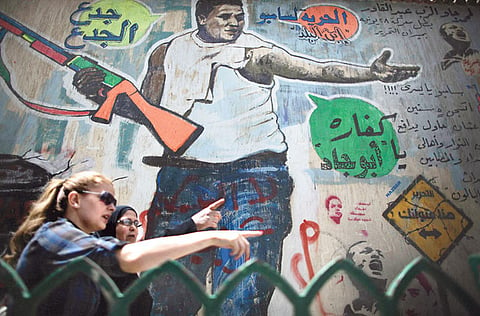
Cairo: Egyptians will make history today as they begin voting in the first ‘real' presidential election, shaking off decades of autocratic rule. It is the birth of the second Egyptian republic following the overthrow of the monarchy by a military coup in July 1952 and the January 25 revolution, which led to the ouster of the Hosni Mubarak regime in February 2011.
"This election has broken the state of fear. I no longer feel afraid; I can choose whoever I want, not just who I am told to choose," Egyptian expatriate Nassef Nabeeh, an Abu Dhabi resident, told Gulf News.
In 1952, Mohammad Najeeb and Jamal Abdul Nasser, both military officers, led a bloodless coup which overthrew King Farouq. They became the first and second presidents of the Egyptian republic respectively.
When Nasser, champion of pan-Arabism died, vice-president Anwar Sadat assumed the presidency. Under Sadat, Egypt signed a historic peace treaty with Israel in 1979.
Only two years later, Sadat was assassinated, paving the way for three decades of Hosni Mubarak's autocratic rule. Mubarak was ousted on February 11, 2011, following a popular uprising now known as the January 25 Revolution.
A military council took over power and began the process of transferring power to a democratically-elected government.
Nonetheless, many Egyptians remain sceptical whether the military, the backbone of Egyptian politics for decades, will actually hand over power to an elected president. This fear, however, has not dampened public enthusiasm. "I feel proud that I can help make the decision of who will run my country, I have a voice now, I can say yes or no." Egyptian expatriate Azza Sobhy, an Ajman resident, said.
Huge responsibility
Thirteen presidential hopefuls, including three Islamists and two Mubarak-era officials, are contesting the election.
The frontrunners are former foreign minister Amr Mousa and moderate Islamist Abdul Moneim Abu Al Fotouh. Mubarak's last premier Ahmad Shafiq; the head of the Muslim Brotherhood's Freedom and Justice Party Mohammad Mursi; and opposition leader Hamdeen Sabahi are prominent candidates.
The winner will shoulder the enormous responsibility of leading the country through a tenuous transition to democracy and directing the rewriting of the Egyptian constitution.
Egypt's 50 million voters are now faced with a choice: do they want a republic governed by Sharia, a liberal state, or a guided democracy with the military as guarantor, wielding power behind the scenes.


