Egypt election empowers youth
Mubarak only President Egyptian youth, more than 60% of nation’s 82m population, have known
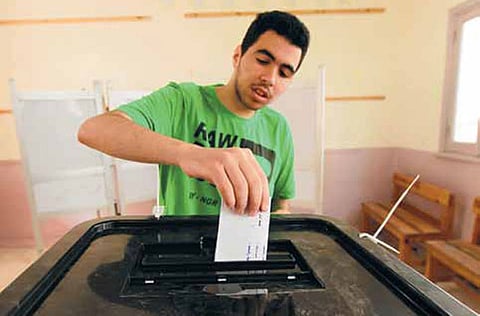
Cairo: In 2005, Hussam Al Khudairi was 15 years old and was too young to vote in Egypt’s first multi-candidate presidential election called by then president Hosni Mubarak after 24 years in power. Voting age in Egypt starts at 18 years.
Mubarak, then 77, swept the election and got his fifth term as president.
“Even if I had the right to vote at the time, I would not have gone to the polls because Mubarak’s win was a foregone conclusion,” Al Khudairi, an engineering student, said.
Vote 'rigged'
“I remember that my father did not vote at that time nor did he voted in any previous poll because he was sure that his vote would have been rigged, as all elections in the past were a farce,” Al Khudairi added.
He and his family, who live in the upmarket district of Heliopolis in eastern Cairo, are enthusiastic to vote today in what is widely viewed as Egypt’s first real presidential election. “My 20-year-old sister and I are particularly happy because it will be the first time for us to vote and see a democratically-elected president,” Al Khudairi said.
The youth, who account for more than 60 per cent of the nation’s 82 million population, have not seen any president other than Mubarak. He ruled for nearly 30 years until a popular revolt deposed him in February last year.
Like many young Egyptians and liberals, Al Khudairi is worried about the rise of political Islamism and its monopoly to power in the country.
“It would not be a good representative of the revolutionary Egypt if an Islamist candidate becomes the new president,” he said. “After all, the revolution against the Mubarak regime did not erupt for religious reasons, but to end social and political woes.”
Both houses of Parliament
Islamists, whose political influence has grown since Mubarak’s ouster, control both houses of parliament. They are likely to dominate the government, which will be formed after the elections.
Many young people have campaigned against the Islamists or a Mubarak-era official standing for president.
The 13 presidential hopefuls include three Islamists – the powerful Muslim Brotherhood candidate Mohammad Mursi, the moderate Islamist Abdul Munem Abu Al Fotouh, and the former head of the International Union for Muslim Scholars, Salim Al Awa.
Amr Mousa, a former foreign minister under Mubarak, and Ahmad Shafiq, an ex-army general and Mubarak’s last prime minister, are also running for president.“Should the next president be an Islamist, this would mean a new-look dictatorship,” Marwa Mustafa, a medical student at Ain Shams University in Cairo, said. “Meanwhile, it would be a big insult to the blood of the martyrs [slain protesters], if anyone from Al Felul won the presidency,” she said.
Biased
“I hope that the new president will not be biased towards a certain group, will seek to create a civil state in Egypt and most importantly will be keen to bring to justice all those involved in killing the martyrs in the 18 days of the revolution and...during the transitional period ruled by the military,” Mustafa said.
Should no candidate secure a clear majority in the first round of the election, a run-off vote will be held on June 16 and 17.


