World's second cloned camel born in Dubai
The male calf, named Bin Soughan, was born after an uncomplicated gestation
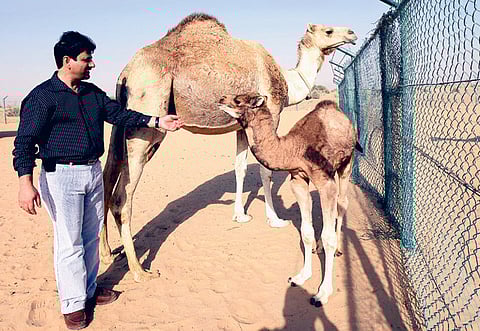
Dubai: The Camel Reproduction Centre (CRC) in Dubai has announced the birth of the world's second cloned camel.
The male calf, named Bin Soughan, was born at 3am on February 23 after an uncomplicated gestation of 383 days. He was cloned from cells harvested from the skin of an elite bull; the first time a camel has been reproduced from the cells of a living animal.
Injaz, the world's first cloned camel, was produced from the ovarian cell of a camel that was slaughtered for its meat. She will be one year old on Thursday.
Dr Nisar Ahmad Wani, Head of the Reproductive Biology Laboratory at the CRC, said: "The ability of skin cells to reprogramme and develop into an embryo has made the process of cloning camels easier as skin cells are easy to obtain in contrast to reproductive tissue. This will help us in the amelioration and preservation of genetically valuable animals like high milk producers, racing champions and males of high genetic merit".
Bin Soughan's birth heralds another significant breakthrough for the centre as he was cloned from cells harvested from the skin of an elite bull whereas Injaz, the world's first cloned camelid, was produced from the ovarian cells of a she-camel.
Great acclaim
Injaz has received great acclaim from the global scientific community in the year since her birth. She appeared alongside her surrogate mother on the front cover of the Biology of Reproduction, an American scientific journal published by the Society for the Study of Reproduction.
Dr Wani added: "Bin Soughan's birth is a great achievement because he was produced from the skin cells of a live animal, which makes the process a lot easier. There are no major techniques involved; all we need is a pinch of skin whereas with Injaz we required cells from the reproductive organ.
"This [birth of Bin Soughan] has opened new doors in terms of cloning live animals. It will also help improve our efficiency and the process could be used to multiply our elite racing camels."
The CRC was founded 21 years ago. It is supported and financed by His Highness Shaikh Mohammad Bin Rashid Al Maktoum, Vice-President and Prime Minister of the UAE and Ruler of Dubai.
Aside from Injaz, the centre had another success in 2008 when identical twin camel calves, Zahi and Bahi, were born. The male twins were produced using a technique called embryo micro-manipulation.
