Who needs a male anyway? Virgin shark gives birth once more
Female zebra shark at Burj Al Arab aquarium continues to spawn baby sharks without mating
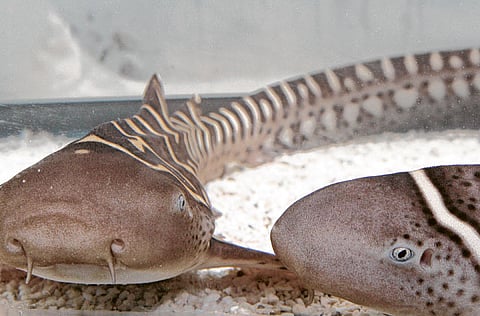
Dubai: Zebedee may have never met a male of her species, but that hasn't stopped the nine-year-old female zebra shark from reproducing on a recurring basis.
In a phenomenon that has defied everything science ever knew about the zebra shark, Zebedee, who lives in an aquarium at the Burj Al Arab Hotel, has been giving birth for the past four years, a first-ever for her species, reveals Warren Baverstock, Aquarium Manager at Burj Al Arab and co-author of an article featured in the Journal of Fish Biology.
Baverstock and co-author, marine biologist and assistant aquarium manager David Robinson explained the reason the news wasn't brought to public attention was because tests had to be carried out, DNA had to be sampled, research conducted and theories approved, before making a statement that could potentially change the way we view zebra sharks forever.
For the scientifically inclined, the process is called parthenogenesis. To the rest of us, it's when an egg cell is triggered to develop as an embryo without the addition of any genetic material from a male sperm cell.
Perhaps even more surprising than the fact that Zebedee does not need a male to reproduce, is the possibility of her spawning an entire breed of pups who will grow into full-blown adults capable of parthenogenesis themselves, perhaps eradicating the need for the male altogether.
"It's not quite that simple," says Robinson. "All 21 pups are still young, with the eldest being one and a half years old and the youngest just a few months.
"We have approximately six years of waiting before we find out whether Zebedee's offspring will reproduce exclusively through parthenogenesis, or would mate with a male if the opportunity arose, or would be able to alternate between the two styles of reproduction."
For now, all these possibilities are just theories.
And as is the case with theories, they come attached with a lot of scepticism, with critics saying that the pups may not be able to display the same ability as the mother, or, since the pups are clones of the mother, sexually, they have no ability of their own.
"Parthenogenes are not clones of their mother," explains Robinson. "They're genetically different to each other and to her as well. They are parthenogenes, not clones [who are unable to reproduce on their own]. There is no reason why they can't be reproductively viable. They have a normal reproductive system that we've seen and learnt about through post-mortems of the pups that didn't survive."
In layman's terms, sexual reproduction results in offspring with two versions of every gene (one from each parent) while asexual reproduction leads to offspring with only one version of every gene.
"Sharks continue to inspire and amaze us with their remarkable adaptability," adds Baverstock. "There is no wonder that sharks have been such an evolutionary success story. A lot of hard work has been put into this project by the Burj Al Arab aquarium team and I am glad to see the effort and research are successful."
Although "virgin births" are known among invertebrates and some vertebrates such as hammerhead, black tip and bamboo shark, it was unheard of for a zebra shark to display this ability. "At first we had to eradicate all doubt of the possibility of her having had intercourse with a male shark of a different species," says Robinson. "We tested her, we tested the male hammerhead shark and we tested all her pups to find out if the babies carried any DNA that didn't match the mother's. Our result showed no paternal DNA at all."
Moreover, when examined, Zebedee had none of the bite marks that are usually inflicted on her gender during mating. Nor was it possible for her to store the male sperm in her body for future use (sharks have that ability), since her six years in captivity would have made the sperm redundant.
"Working closely with Dr Khazanehdari of the Central Veterinary Research Laboratory, we have confirmed that parthenogenesis took place through the DNA analysis of Zebedee's offspring. This discovery is extremely exciting for us as researchers and raises further questions about what we thought we knew about shark reproduction."
21
pups have been delivered by zebedee till now


