Workers live in filth after employer absconds
Employer absconds leaving 700 workers to survive in squalid living conditions in Sharjah
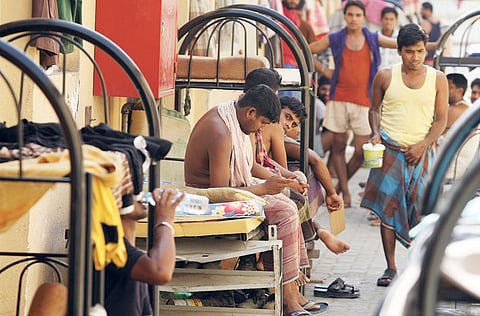
Dubai: Up to 700 workers, unpaid for six months, have been living in two adjacent labour compounds since the beginning of Ramadan in squalid conditions without water or electricity in the Sharjah Industrial Area.
With the utilities cut off for the third week running, the workers, many of whom are fasting, are forced to live in the heat and bad sanitary conditions, with the toilets piled with waste, and garbage scattered around their dwellings.
Their employer, the chairman of Dubai-based Saqr Engineering and Contracting Company, is believed to have absconded, leaving workers from India, Pakistan, Nepal, Bangladesh and the Philippines stranded without pay in the UAE. Gulf News visited the office of Saqr Engineering and Contracting Company, which was closed.
A silent partner in the company who did not want to be named said that the chairman had "fled the UAE leaving me and these workers in trouble".
"We are trying to solve the problem but he is the only one with signing authority. Ideally we would have liquidated the company, sold the assets and sent the workers back," he said.
The partner said however that it is unlikely that the company will be able to pay the workers their dues, since it does not have the money to do so. "For now, priority is to get these workers out of this situation," he said.
Workers said they had registered complaints at the labour ministry, however the ministry spokesperson did not respond to Gulf News' request for a comment by time of going to print.
Speaking to Gulf News, many of the workers said they have not been paid for five to eight months. Salaries range from Dh800 to Dh1,000.
"Those of us who fast have to eat dry bread and green chillies for suhour (pre-dawn meal). There is no water to wash ourselves and we cannot even use the toilets," said Abdul Wahid, a Pakistani steel fixer.
Stench of sweat
A pungent stench of sweat and dirty laundry permeates the rooms and open-air corridors that are strewn with clothes, shoes and cooking vessels. Creaky bunk-beds are carted outdoors where ground space is covered with mounds of scattered rubbish, to make bed space in the night.
A gas tank sits inside one of the rooms with no consideration for fire hazards, while the stove itself sits on one of the many beds dragged outside the rooms.
Even as the sewage overflowed, some workers continued to use the toilets in unhygienic sanitary conditions, while others chose to walk to neighbouring camps to wash. "Some of us haven't had a shower in more than a week," said one of the workers.
A worker from Pakistan lay in his bed as another worker fanned him. He said that he had been suffering from severe diarrhoea and fever for the past four days.
A Nepalese worker, Shahid Iqbal, lifted his shirt to expose red spots all over his chest. Asked what they were, he shrugged. "I don't know. Could be chicken pox. I can't go to the hospital."
Workers say that their health cards have expired, and the company has not replaced them.
Temporary relief is offered to these workers by a Nepalese and several Indian social and voluntary organisations, such as the Kerala Youth Cultural Centre (KYCC), Vadakara NRI Forum and the All Kerala Colleges Alumni Foundation, which supply a small ration to the destitute workers.
"We have also been bringing tankers to supply water to the workers, bringing 500 gallons per visit," said Sadiq Cheruvathottu, a KYCC volunteer.
"On the receipt of complaint from 234 Indian workers on August 22, consulate has taken up the matter with the concerned authorities in the local government for expediting the repatriation of the workers after obtainment of their pending salaries. Simultaneously, we have made arrangements for providing for food and other requirements for them," said a spokesperson for the Indian Consulate.
"What are we expected to do after Ramadan?" asked one worker. "We don't want charity or donations," said a Pakistani worker who did not want to be named. "Charity is for the poor. We have worked here and deserve our dues. We still have our honour."


