Case for paternity leave in the UAE
Experts in human resources call for changes at a policy level in the UAE
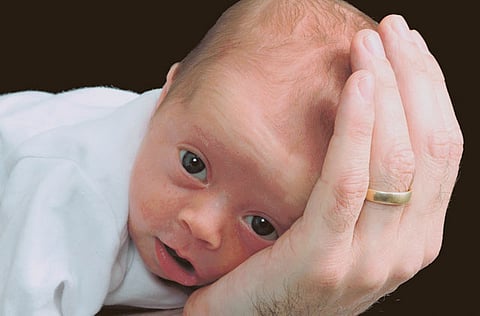
Dubai: Only a few companies in the UAE provide paternity leave benefit, others don't. Why?
It's a debate alright. An ongoing one at that. The subject of paternity leave or employee benefit given to the father to take care of his infant, continues to moot the need for acceptance at a policy level in the UAE.
The advantages of this form of leave have set their own track record in Western countries. In the Middle East though, paternity leave is believed to be a blind spot. Mandeep Singh, Director - HR Advisory, Grant Thornton UAE, told Gulf News, "There is merit in a prescribed paternity leave policy under the country's labour law. However it isn't common practice in the UAE."
Singh, who has worked on policies and procedures, talent management and reward mechanisms for several clients, explained that the policy for paternity leave is in place in large, local companies and MNC's operating in the UAE and other GCC countries.
"In Qatar for instance, some companies limit the paternity leave policy to three children, some do not have a limit. In my experience, more and more UAE organisations are open to introducing employee-friendly policies like that of paternity leave."
This kind of policy needs lobbying, believes Sheloob Said, another Dubai-based HR Professional. He told Gulf News that is he struggling to get his current company to understand the benefits of such a policy.
"I need to convince the management that this policy is beneficial for the company and the employee - family welfare/employee welfare value. I was able to introduce and implement it with two of my earlier companies. I believe that a paternity policy is the outcome of companies that are organised and focus on productivity-based planning."
At a recent seminar conducted by The Dubai School of Government, Aisha Al Suwaidi, CEO of HR Policies Sector (Acting) of the Federal Authority for Government Human Resources (FAHR), told Gulf News that paternity leave is also an important cultural element.
She said that the provision of such a policy will highlight the role of the man in a family set-up where a husband should support his wife, who in today's culture is educated and holds a good job.
"Without male support, women will not be promoted, recognised or acknowledged. Men and women need to think of each other as complementary beings, not competitive," she said.
Speaking on the importance of paternity leave as a tool to further the economic empowerment of women, Manal Ataya, Director General of the Sharjah Museums Department that employs more than 500 staff — of which more than half are UAE nationals with a high percentage of women in senior management — told Gulf News that new policies should be devised and reviewed to give working men and women the opportunity to pursue careers.
"It will facilitate active participation in family life, and will help [working] men and women achieve and enjoy a work/life balance. This can only result in a stronger society and sustainable development of the UAE," she said.
Singh supported Manal's opinion, saying, "It is the right time for the labour authorities to look at institutionalising policies like these, given the emphasis on encouraging women in contributing to economic development of the country. Apart from existing direct initiatives that promote and recognise women in the corporate world, a paternity policy will be an indirect way to support women."
The benefits of paternity leave are well established. Nicola Ablett, Director of Ablett, told Gulf News that Aldar, in 2005, introduced three days' paternity leave and Emiratis welcomed it. "As a result, they were more productive."
Ablett has worked for 16 years in Abu Dhabi with federal and local authorities, and now runs her own company. She referred to an EU Policy document (2010) that highlighted the crucial role paternity leave plays on the societal and familial level, and how it supports families to contribute to social reproduction, guarantee a good start in life for children, protect the wellbeing of mother and child, and help families achieve work/family balance.
She told Gulf News: "Pat-ernity leave is highly relevant to countries in the MENA region as women are increasingly highly educated and role models for the female children in all aspects of public life. Men, who are in successful marriages, want to know their children and be part of their growing up — a luxury that perhaps their parents and grandparents were not able to enjoy. I am fortunate to know many Emiratis who enjoy this status."
Ablett explained that expectations have changed. "Work-life balance is crucial, and with the current economic situation more often than not both parents must work to attain or maintain the lifestyle they are accustomed to. The blurring of roles and expectations is even more compelling for paternity leave to ensure a family bond."
Ablett hopes that the benefits will translate into a policy in the UAE. "The more engaged a father is with his wife and newborn, the more it will translate into a successful bonding for all parties. When there are other children involved, it also helps with the introduction and consistency of care given while the mother is away from home.
"Given the rates of divorce any ‘bonding' and increased family time indicates long-term benefits. A family-oriented man with a committed family attitude will be attracted to a job which offers him paternity benefits and flexible working hours, and will undoubtedly be more loyal to the company that offers these [benefits].
"It can only be an investment in families and therefore a major investment in the human capital," she said.

