Islamists, secularists in tight race for top job
13 presidential hopefuls in the fray
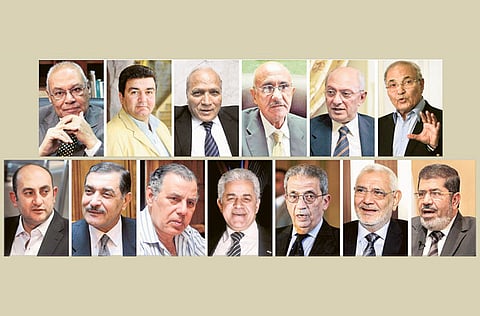
Cairo: Thirteen presidential hopefuls, including three Islamists and two Mubarak-era officials, are scrambling to win Egypt's top post in a tight race, the result of which is set to shape the country's political landscape for the next four years.
The leading contenders in the election, Egypt's first since Hosni Mubarak's toppling in February last year, are former foreign minister Amr Mousa; moderate Islamist Abdul Moneim Abu Al Fotouh; Mubarak's last premier Ahmad Shafiq; the head of the Muslim Brotherhood's Freedom and Justice party Mohammad Morsi; and opposition leader Hamdeen Sabahi.
Mousa, who served for 10 years under Mubarak before being named as the Arab League's chief in 2001, portrays himself as a veteran statesman whose experience and relations with the outside world will reinvigorate the Egyptian economy and re-establish stability in the country.
As a secular-minded candidate, Mousa, 75, appeals mainly to the Christian minority and liberals who are worried about the rise in Islamists' influence in Egypt since Mubarak's fall.
Popularity
Shafiq, an ex-army general, who served as a prime minister in the final days of Mubarak's rule, is vying with Mousa for such voters. Shafiq's popularity with the Christians has recently increased after his promise to appoint a Christian woman as a vice-president if he wins.
Shafiq, 70, also woos voters who are eager to see an end to street turmoil that has gripped Egypt since Mubarak's ouster.
The military, who has been ruling Egypt since Mubarak's ouster, has repeatedly pledged to hand over power to an elected president by June 30. The generals have denied claims they support a certain presidential runner.
Shafiq has taken the lead in three opinion polls published this week. His opponents have vowed to stage street protests if he becomes a president— a threat downplayed by Shafiq as undemocratic.
Defying ban
Despite his painstaking effort to portray himself as a moderate Islamist able to achieve national harmony in Egypt, Abu Al Fotouh, a medical physician, raises doubts of the Christian minority and liberals, due to his background as a former senior official in the Muslim Brotherhood.
The group, which controls the two houses of the post-Mubarak parliament, expelled Abu Al Fotouh last year after he announced his intention to run for president, defying a ban imposed by the Brotherhood on its members from contesting presidential election.
Abu Al Fotouh, 60, has said that if he becomes a president, he would not "forgive any official whose hands are stained with Egyptians' blood or stealing their money".
Vying with Abu Al Fotouh for Islamists' votes is the Brotherhood's candidate, Morsi, who depends on the group's large grassroots base rather than his popularity. However, Morsi's win will trigger fears about the group's monopoly of power in Egypt and a possible adoption of a hardline, mainly against the Christians and secularists.
To the youth who removed Mubarak from power, Sabahi, a 58-year-politican, is the best choice. Some young Christians have said they will vote for Sabahi instead of electing the Mubarak-era officials: Mousa and Shafiq.
Known for his opposition to Mubarak, Sabahi is a pronounced follower of late populist president Jamal Abdul Nasser and his socialist policy.
Sabahi is also an outspoken critic of Israel, which he calls the "Zionist entity". He is also a frequent critic of the military rulers.
While all the 13 presidential contenders have pledged to strengthen the army, they are at odds on the military's future political role and budgetary issues. The ruling generals insist that the Supreme Council of the Armed Forces should be responsible for the army's affairs, including its budget, which they say the parliament may debate but behind closed doors.
The council also demands that its approval should be mandatory before passing army-related legislation.


