Slump sends Europe deeper
Downturn spreads to germany, france as china's industrial sector declines
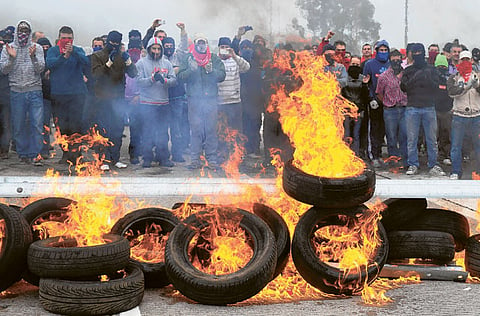
London: The shadow over the global economy darkened this month as the Eurozone's private sector contracted, US manufacturing growth slowed and China's once-booming factories faltered, surveys showed yesterday.
In Europe, a downturn that started in smaller states on the Eurozone's periphery is now taking root in the core countries of Germany and France, where tepid growth had been the main thrust of support for the euro area economy.
Britain's Deputy Prime Minister Nick Clegg warned a Greek exit from the Eurozone could have drastic consequences for Europe, and called for a new "grand bargain" to help even the field between the monetary union's haves and have-nots.
Following talks with German Foreign Minister Guido Westerwelle, Clegg added there should be no delusions about what it would mean if Greece decided to leave the 17-nation bloc of countries using the euro.
Britain is not a part of the Eurozone, but its economy depends on the amount of business it does with continental Europe.
"No one should labour under the false hope that somehow Greece leaving the Eurozone would provide instant relief to the problems we face," he said.
"If any member country were to choose to leave, it would have an unpredictable knock-on effect not only on members of the Eurozone, but on the European Union, including Britain, and, indeed, on the global economy."
Markets take a battering
The uncertainty over Greece's future in the Eurozone is battering the country's financial markets, with investors unconvinced by European leaders' pledge to keep the country in the euro bloc.
Shares on the Athens Stock Exchange hit a new 22-year low yesterday, closing down 4.5 per cent at 502.52, despite gains made elsewhere in Europe.
"We are in a period of weakening global growth. It doesn't quite feel like 2008 yet but the danger is we could get there quicker than we think," said Peter Dixon at Commerzbank.
The Eurozone composite PMI, comprising the services and manufacturing sectors, fell to 45.9 from April's 46.7, its lowest reading since June 2009 and its ninth month below the 50-mark that divides growth from contraction.
The data sent German Bund futures to a record high as investors sought relative safety, and the euro neared a two-year low against the dollar.
Wednesday's news that European Union leaders have been advised by senior officials to prepare contingency plans in case Greece quits the single currency also hurt the euro.
Europe's woes were also felt across the Atlantic.
Financial information firm Markit's "flash" US manufacturing Purchasing Managers Index slipped to 53.9 in May from 56.0.
Markit, which compiles the Eurozone PMIs, released its US index for the first time yesterday but has been tracking data in the entire sector since late 2009.
"The cause seems to lie largely with weak export sales, which likely reflects the deteriorating economic situation in Europe as well as slower growth in China," said Markit chief economist Chris Williamson.
HSBC's Flash China PMI, the earliest indicator of China's industrial sector, retreated to 48.7 in May from 49.3 in April. It marked the seventh straight month the index has been below 50.
The figures signal sluggish economic conditions of the first quarter are set to continue throughout the first half of the year in China's longest slowdown since the global financial crisis.
Forecasts fall short
"The series of highly disappointing April activity data - exports, imports, industrial production and retail sales indicators all fell short of even the most pessimistic forecasts.
"The first gauge for economic activity in the current month is a further signal that internal and external headwinds are still biting into economic momentum," said Nikolaus Keis at UniCredit.
The HSBC PMI has provided a contrast to the Chinese government's official PMI, which includes more state-owned firms with better access to credit.
The government PMI hit a 13-month high of 53.3 in April as exports ticked higher although domestic orders showed signs of weakness.
In Europe, even the core countries are in trouble. The manufacturing sector in Germany, Europe's largest economy, contracted at a far greater pace than was expected, and its service sector saw minimal growth.
In France, both sectors have contracted faster than was predicted by most economists.
German business sentiment also dropped for the first time in seven months in May, the Ifo think tank said, missing even the most conservative forecasts.
Across the channel, Britain's economy shrank by more than initially thought between January and March, hit by the deepest fall in construction output in three years.
For the Eurozone, Markit said the composite reading was consistent with gross domestic product, which stagnated in the first quarter, falling by at least 0.5 per cent across the region.
"The flash PMI figures for May provide a clear warning that Eurozone GDP will almost certainly show a contraction in Q2 after stagnating in Q1," said Martin van Vliet at ING.
Commerzbank's Dixon said, "It clearly indicates the evaporating sentiment as the Greece crisis has intensified is having a big impact on the economy."


