Al Arabi sees fall of regime soon
Facts on ground indicate very clearly opposition is gaining, Arab League chief says
Cairo: Syrian President Bashar Al Assad’s regime is in danger of collapse “any time” as the opposition gains ground on the military and political fronts, Arab League chief Nabeel Al Arabi said on Monday.
“That could happen any time,” the secretary-general said in an exclusive interview.
“Now they are fighting in Damascus,” and, after 20 months of violence, “I think there will be something soon,” he said.
“Facts on the ground indicate very clearly now that the Syrian opposition is gaining, politically and militarily. Every day they are gaining something,” Al Arabi said.
He said a new coalition of Syrian opposition groups now based in Cairo was “moving ahead”.
The Arab League, which is also based in the Egyptian capital, last month recognised Syria’s National Coalition as the “legitimate” representative of the Syrian opposition.
“We are in touch with them and they come here all the time,” Al Arabi said.
According to the Syrian Observatory for Human Rights, the conflict which broke out in March 2011 has cost more than 41,000 lives.
There have also been fears of a spillover of the violence into neighbouring countries.
“The possibility is there, you cannot exclude the possibility,” Al Arabi acknowledged.
He also deplored Russia’s support of Damascus, which along with China has blocked the United Nations Security Council from adopting sanctions against Damascus.
“The Russians insist [Al] Assad should be there until the end of the [transition] process, while others say once the transition period starts with a government with full executive powers, [Al] Assad is needless,” Arabi said.
But he said China, which is also a veto-wielding member of the Security Council, appeared to be “more flexible” than Russia on the Syria file.
Al Arabi’s assessment was that Iran, considered Al Assad’s firmest ally in the international community, is in fact “not a big actor”.
“I keep reading in the papers Iran is providing money, Iran is providing weapons ... They deny everything but they say they are helping” Damascus, Al Arabi said.
“I don’t expect Iran to change its views. They are dogmatic but they are not so influential,” he said.
The six-nation Gulf Cooperation Council has recognised the National Coalition formed last month as “the Syrian people’s legitimate representative”, although the 22-member Arab League stopped short of granting it full recognition.
Spain on November 29 also decided to recognise the National Coalition, following the example of France, Britain and Turkey as well as the GCC.
The 27-nation EU has formally recognised the National Coalition as the sole representative of the Syrian people, while France has suggested arming opposition fighters.
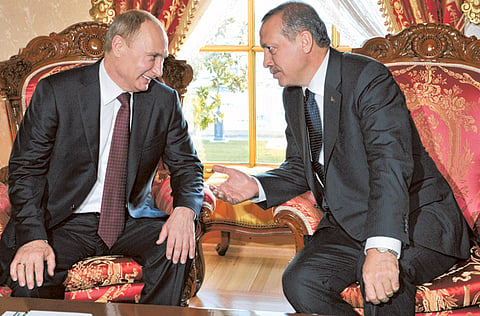
Meanwhile, Russian President Vladimir Putin met Turkey’s prime minister for talks expected to cover their opposing views on the conflict in Syria.
On the battlefield, artillery and aircraft battered rebel positions in and around Damascus on Monday in an operation to secure the capital, a monitoring group said.
Putin landed in Istanbul and went straight into talks with Turkish Prime Minister Recep Tayyip Erdogan, whose country is at loggerheads with Russia over how to tackle the crisis in Syria, despite growing trade and energy links.
Those tensions came to a head in October when Turkey intercepted a Syrian plane en route from Moscow to Damascus on suspicion it had military cargo, drawing an angry response from Russia.
Ankara said the cargo contained military equipment destined for the Syrian defence ministry. Moscow insisted it was dual-purpose radar equipment which was not banned by international conventions.
Turkey, once an ally of the Damascus regime, has become one of its fiercest critics. But Moscow remains one of President Bashar Al Assad’s few allies, routinely blocking resolutions against his regime in the UN Security Council.
Russia also objects to Turkey’s request to Nato for the deployment of Patriot missiles near its volatile border with Syria. It has warned such a move could spark a broader conflict that would draw in the western military alliance.
The Syrian Observatory for Human Rights reported that artillery gunners on Sunday night targeted the Damascus districts of Hajar Al Aswad and Tadamun as well as the Palestinian refugee camp of Yarmuk in the south of the capital.
The army bombarded Yabrud to the north, Yalda to the south and the Eastern Gouta towns of Douma, Harasta, Irbin and Haran Al Hawamid, in the area of the road linking Damascus to its international airport, it said.
In the south, aircraft bombed Beit Sahem and its orchards as fierce clashes raged on the ground between troops and rebels, the Observatory said.
The pro-regime newspaper Al Watan said: “To keep securing the road to Damascus international airport from the south, the army is continuing its drive in Al Hujeira, Aqraba, Beit Sahem.”
Forces loyal to Al Assad have been trying to establish a secure perimeter around Damascus at all costs, turning the province into one of the main battlegrounds in the country’s 20-month conflict.
Analysts say the objective is to put the regime in a position to negotiate a way out of the conflict that the Observatory says has cost more than 41,000 lives since March 2011.
In central Syria, the Britain-based Observatory also reported clashes with rebels since Sunday in the central city of Hama, prompting authorities to send in reinforcements.
The Observatory, which relies on a network of activists and medics in civilian and military hospitals, said a total of 134 people — 58 civilians, 41 soldiers and 35 rebels — were killed in countrywide violence on Sunday.