On track to success
The country’s wealth of natural resources has served as a cushion in difficult times
If the political scene has been a little uncertain of late, the Australian economy has been less so. Not many Western countries can say that.
There can be no doubting Australia's remarkable run, enjoying growth averaging 3.5 per cent for more than 15 years. Having suffered only one quarter of contraction, it even managed to avoid the definition of recession in the recent meltdown.
Politicians being politicians like to claim responsibility for this performance — reasonably or not — but the country's wealth of natural resources has been an obvious cushion.
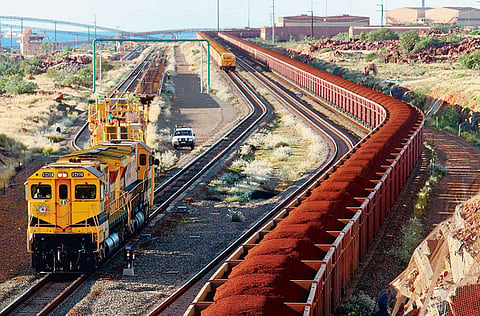
Australia is a major provider of mainstream agricultural products such as wheat and wool, likewise of minerals, for instance iron ore, and gold, much-favoured in troubled times. Ditto in energy, whether in traditional form, like coal, or modern guise like liquefied natural gas (LNG). What's more, it has barely scratched the surface in tapping many of these resources.
That's an underlying support in terms of stock. Issues of flow have been beneficial too, namely the rise of Asia and its needs.
The eastern swing
Once focused on Europe and North America, Australia's trade relations have shifted east. China now accounts for approaching 23 per cent of exports. Japan makes up 19 per cent, South Korea and India about 8.5 per cent each, the US not quite 5 per cent.
China's emerging dominance has leveraged its call on commodities, and feeding its insatiable steel mills has underwritten Australia's boom for much of the past decade. The export surge has continued through the economic crisis. Latest trade figures shocked economists, the surplus for June coming in at a bumper $3.6 billion (Dh13 billion), nearly double expectations.
Yet good management rather than good fortune has been critical to the banking system, so hobbled in other parts of the world.
Aggressive stimulus
Shielded from takeover by the so-called Four Pillars policy instituted by the Keating administration in 1990, the country's main banks have been further protected by a strong domestic focus and tight regulation from a single body, the Australian Prudential Regulatory Authority.
These economic crutches notwithstanding, the Australia government delivered an aggressive stimulus in the past three years to ward off a dangerous, downward spiral. Its fiscal package for the period 2008-2010, totalling A$80 billion (Dh274 billion), actually ranks third internationally as a percentage of GDP at more than 6 per cent, behind only the US and South Korea.
The scale of that deliberate boost has been at the heart of recent election debates, the Liberals claiming a degree of wasteful spending and Labor that such impetus prevented deep recession and massive unemployment.
Alongside, the Reserve Bank of Australia (RBA, the central bank) lowered its benchmark interest rate to 3 per cent, the lowest level in 49 years. Critics of the measures say the speed with which the RBA has been forced subsequently to raise rates, with more flagged, suggests the scale of the stimulus was unwarranted.
Market analysts say the official interest rate is likely to rise to 5 per cent by the end of this year, heading higher, and inflation to breach 3 per cent during 2010-11. Fiscal stimulus is being withdrawn faster than in most other advanced economies, and ahead of the timetable suggested by the IMF for the G20 nations.
As a result of an improved economy, the budget deficit, just 2.9 per cent in 2010/11 is expected to peak at no more than 4.2 per cent of GDP, and surpluses could return as early as 2015.
Debt is forecast to peak in three years at A$94 billion, at just above 6 per cent of GDP, compared with more than 90 per cent in some other industrial countries.
Bright outlook
The outlook for the Australian economy is bright. According to the IMF it will remain a world leader in the global recovery, with stronger growth, lower unemployment and much lower debt than other advanced economies. It forecasts GDP growth of 3.0 per cent in 2010, and 3.5 per cent in 2011, supported by Asia's momentum. The Fund forecasts that unemployment will hold at its present rate of 5.3 per cent this year and dip down to 5.1 per cent next year, significantly better than among other counterparts.
Local economists agree with the IMF's upbeat prognosis. Westpac's latest bulletin commented that the economy expanded more than expected in the second quarter, with 3.3 per cent year-on-year growth having been boosted by strong trade figures, and despite a reduction in government investment spending.
The problems of debt inhibiting overseas growth and markets is expected to constrain Australia's growth rather than stifle it altogether, considering the global shift of economic weight.
Emerging trend
If anything will hold economic growth back, it might be an emerging trend of frugality among consumers and a sluggish construction recovery, according to the latest Access Economics Business Outlook report. Such is the damage to confidence in the ‘bust' phase, even just relatively so, compared to ‘boom' times.
But that is likely to be only a minor drag at most. Upon solid foundations, Australia has been seen through recession relatively comfortably, through some combination of luck and judgement.
Mineral matters
Not surprisingly Australia has some of the world's leading mining companies, none larger than BHP Billiton with recently announced annual sales for the year to June of $52.8 billion (Dh193 billion).
The Australian arm of the business dates back to 1885. Expansion through both acquisition and organically has broadened its range of commodities, and the company continues to grow. Last month it launched a $39-billion (Dh143-billion) bid for the Canadian company PotashCorp, the world's largest fertiliser group.
With substantial operating profits, BHP Billiton and similar companies became targets for government fund-raising. Plans were made earlier this year for a 40 per cent ‘resource super-profits tax', expected to generate A$9 billion (Dh30 billion).
Joining forces
The leading companies joined forces to fight the proposal on the basis that it would kill the country's ‘golden goose', destroying what saved the economy from the global downturn.
The proposed blow was later softened. The tax was renamed the ‘mineral resources rent tax', and the penalty rate lowered from 40 to 30 per cent and confined to iron ore and coal, Australia's top two export earners and commodities that have benefited greatly from growth in Asia's emerging economies. Also the definition of ‘super-profit' was also doubled.
A shift in trade
Once focused on Europe and North America, Australia's trade relations have shifted east. China now accounts for approaching 23 per cent of exports. Japan makes up 19 per cent, South Korea and India about 8.5 per cent each, the US not quite 5 per cent


