Day-after images of Melor's fury: Typhoon leaves trail of destruction, another storm seen
Central Philippines in darkness; 4 killed, numerous houses destroyed as new storm seen
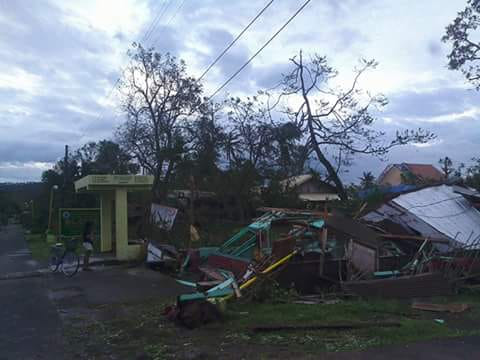
Bulan, Sorsogon, Philippines: Tropical storm Melor left a trail of death and destruction in eastern and central Philippines as up to 170-kph gusts flattened houses, felled trees and knocked down electric posts, plunging a wide swathe of Bicol and Samar regions into darkness.
At least four people were reported killed in the storm that hit as the country prepares for Christmas holidays.
Day-after images posted on social media and initial reports from Sorsogon province, one of the hardest-hit areas, show huge trees knocked down, while scores of fishermen's and farmer's houses were destroyed.
Several provinces were plunged into darkness on Tuesday as the powerful typhoon pummelled the coconut-growing region, causing flooding, storm surges and forcing almost 800,000 people to evacuate their homes, officials said.
On Tuesday afternoon, Typhoon Melor has made its fifth landfall in Mindoro province as the National Disaster Risk Reduction and Management Council (NDRRMC) remained on red alert status.
The Philippine Coastguard prohibited small boats from sailing due to heavy current and winds brought by Melor.
Melor was packing winds of up to 170 kph but weathermen said the storm is weakening.
"Melor will continue to weaken as it crosses the central Philippines into Tuesday," weather provider Accuweather said.
"However, damaging wind gusts will target the rest of southern Luzon to Mindoro."
Romblon residents reported heavy rain and strong winds from midnight. Power was cut as transmission lines and electric posts came down.
Alexander Pama, executive director of the National Disaster Risk Reduction and Management Council, said nearly 800,000 people had been evacuated to shelter areas.
Media reported that three people had been killed on Samar island, where Melor first made landfall on Monday, although this could not immediately be confirmed.
Power services in six central provinces were disrupted and emergency teams were assessing damage to agriculture and infrastructure, Pama said.
Schools and some offices were closed. Dozens of domestic flights and ferry services were cancelled, and the fishing fleet took shelter due to waves as high as 14 metres (46 ft).
Power cut ahead of Christmas
Tattered lanterns, festive lights and tin roofs littered towns in the central Philippines on Tuesday after Typhoon Melor swept through, killing at least four people and leaving millions without power ahead of Christmas.
Distraught survivors surveyed their damaged homes on the eve of the traditional nine-day Christmas vigil that Filipinos observe with dawn masses and rice cakes.
Christmas is the most celebrated holiday in the Philippines, where 80 percent of its 100 million people are Catholic, and decorations such as colourful lights and lanterns have already been put up in most towns.
"It will be a very sad Christmas and a dark one because we have no power. But the important thing is everyone around me is still moving," 54-year-old rice farmer Noemi Pesigan told AFP.
Melor blew out the windows of Pesigan's two-storey brick and wood house in Bulan, a small farming town about 350 kilometres southeast of the capital, Manila, and she survived the storm by sheltering in a nearby shop.
The typhoon tore in off the Pacific Ocean on Monday afternoon and hit farming and fishing communities in the eastern Philippines with winds of up to 185 kilometres (115 miles) an hour.
Three people were killed in floods in Northern Samar province, which faces the Pacific, municipal disaster officer Jonathan Baldo told DZMM radio.
Flying debris also killed a man in Northern Samar, national disaster agency spokeswoman Mina Marasigan told AFP, without being able to confirm the other three fatalities.
Melor weakened slightly as it cut across the central islands of the archipelago, but on Tuesday afternoon its wind gusts were still reaching 170 kilometres an hour as it passed over the island of Mindoro.
It was due to move out into the South China Sea on Tuesday afternoon.
Authorities had yet to make contact with some of the badly hit areas and it was unclear if or by how much the death toll would climb.
Dark Christmas
In Bicol, a vast region in the east often hit by typhoons, authorities credited the early evacuation of 720,000 people for what they believed would be a low death toll.
"We have zero floods, zero deaths, zero casualties," Joey Salceda, governor of Albay province in Bicol, told ABS-CBN television.
But he said the entire province of 1.2 million people was without power.
"What we are asking for is the early restoration of electricity," he said.
Residents of neighbouring Sorsogon, which takes in Bulan town, were also without power on Tuesday, and authorities could give no guarantees if electricity would be restored by Christmas.
"Our target is to restore power by Christmas, but it will still depend on many factors," Mina Marasigan, spokeswoman of the national disaster management agency, told AFP.
She said the timing would depend on how badly damaged towns were, and how much cleaning up of roads was required before teams could go in to put up new power poles and lines.
The Philippines is hit by an average of 20 typhoons a year, many of them deadly, with the strongest often happening towards the end of the year.
Last year, 53 people died in floods and landslides after Typhoon Jangmi hit another part of the eastern Philippines five days after Christmas, catching many people on holidays off guard.
The last deadly storm to hit the country this year, Koppu, killed 54 people and forced tens of thousands to flee their homes after it pummelled rice-growing northern provinces in October.
In November 2013, one of the strongest typhoons on record, Haiyan, flattened entire communities in the central region with tsunami-like waves, leaving 7,350 people dead or missing.
Another tropical storm seen
Another potential tropical system will hit the southern Philippines later this week, Accuweather said.
An average of 20 typhoons pass through the country every year. In 2013, typhoon Haiyan struck the central Philippines, killing more than 6,300 people and leaving 1.4 million homeless.


