Daesh braces for assault on Raqqa
International air strikes intensify on the city in retaliation for the Paris attacks
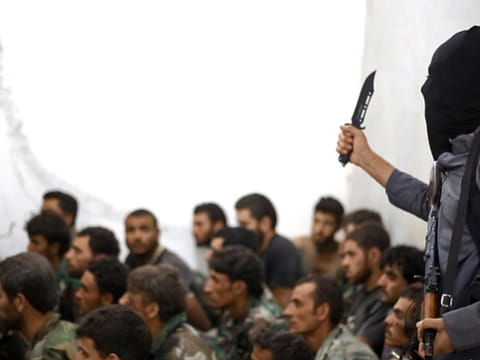
Beirut: Daesh terrorists are stiffening their defenses for a possible assault on their de facto capital of Raqqa, as international air strikes intensify on the Syrian city in retaliation for the Paris attacks. Daesh terrorists are hiding in civilian neighborhoods and preventing anyone from fleeing, former residents say.
The northern Syrian city’s estimated 350,000 people are gripped by fear, rattled by powerful Russian and French air strikes that shake the city daily. They are also worried they would be trapped with nowhere to go amid signs of a looming ground invasion by US-allied Kurdish and Arab forces in Syria, according to the former residents who have fled to Turkey and now report on events in Raqqa through acquaintances and activists inside.
For months, the anti-Daesh forces have been advancing gradually toward Raqqa with backing from American-led air strikes, capturing Daesh-held towns to the north and east of the city. After Daesh claimed responsibility for Friday’s carnage in Paris that killed at least 129 people, there are calls for even stronger action in Syria.
Iraqi intelligence officials this week told The Associated Press that the operation was planned in Raqqa, where the attackers were trained specifically for this operation with the intention of sending them to France. The attacks came soon after Daesh claimed the downing of a Russian plane in Egypt and deadly suicide bombings in Lebanon and Turkey.
US Secretary of State John Kerry on Tuesday suggested Raqqa would be the new focus.
“My sense is that everybody understands that with Lebanon’s attacks, with what’s happened in Egypt, with Ankara, Turkey, with the attacks now in Paris, we have to step up our efforts to hit them at the core where they’re planning these things,” he said after his meeting with French President Francois Hollande on Tuesday.
But the terrorists are digging in to make any potential assault as grueling as possible. The city, which they have held since early 2014, lies on the Euphrates River at an intersection of major routes from all directions, most through agricultural areas crisscrossed by canals and tributaries of the river. The closest forces from the US-backed Kurdish-Arab coalition called the Democratic Forces of Syria are 50 kilometers to the north in the town of Ain Essa.
The Raqqa activists say the militants have been stepping up defenses of the city since late October, after the Democratic Forces launched their campaign vowing to retake the city. Shortly afterward, Daesh banned people leaving the city and activists said it has stepped up enforcement of the ban in the past few days, leading to fears the group intends to use civilians as human shields in future fighting.
To avoid being hit in their bases, the fighters have moved into residential neighborhoods in empty homes abandoned by people who fled Raqqa earlier, said an activist from Raqqa. He spoke on condition he be identified only by the name he uses in his political activism, Khalid, for security reasons.
“There is major fear in the city, especially with Daesh preventing civilians from leaving the city,” Khalid said.
Khalid, who now lives in Turkey, is in touch with people back in Raqqa. Raqqa residents could not be reached because of an Daesh ban on private Internet access across the city.
Among new measures that have been put in place by Daesh, according to several of the activists, is an order that Daesh terrorists move only in alleys and side streets to avoid detection from the air and not use vehicles at night.
Those measures have intensified after a series of successful hits by the coalition that killed a number of Daesh leaders, including the Daesh terrorist known as “Jihadi John” who appeared in several videos depicting the beheadings of US and Western hostages.
On the roads leading into Raqqa, the terrorists have dug extensive tunnels and trenches, said another activist from Raqqa, who spoke on condition of anonymity for fear of Daesh retaliation. More recently, the militants placed tires filled with fuel on empty barrels around the city, with plans to ignite them in case of an attack to cloud the skies with smoke.
Last week’s capture by Kurdish forces of the Iraqi town of Sinjar near the Syrian border cut off one main route connecting Raqqa to Daesh holdings in Iraq, making movement of fighters and supplies more difficult. On the Syrian side, fighters of the Democratic Forces have been on offensive for the past two weeks in Hassakeh province, northeast of Raqqa. Last week they seized the Syrian town of Hol from Daesh, further crimping its supply lines.
Those forces are now marching south toward the town of Shaddadeh, an Daesh stronghold 150 kilometers east across the desert from Raqqa, Kurdish activist Mustafa Bali said. Once that is taken, they will head east toward Raqqa through the Abdul Aziz Mountain, as well as from Ain Essa and Soureen to the north and northwest of Raqqa.
He said liberating Raqqa would be a major blow and “mark the beginning of the end of Daesh in Syria,” and he called for greater international support for the Kurdish-Arab coalition. But a campaign on Raqqa by the under-armed forces would be costly, even with an intensified air campaign, he said.
“I believe it is going to be a major and long war.”
The attacks on Raqqa since the Paris attacks include:
- Nov. 14: Russian air strikes that activists say struck central Raqqa near the Grand Mosque and the museum building that killed up to 13 civilians in addition to a number of Daesh militants.
- Nov. 15: France’s Defense Ministry said 12 aircraft dropped a total of 20 bombs Sunday night in the biggest air strikes since France extended its bombing campaign against the terrorist group to Syria in September.
- Nov. 16-17: French jets bombed a Daesh training camp and munitions dump in Raqqa.
- Nov. 17: Russian Defense Minister Sergei Shoigu said Russian bombers hit Daesh positions in Raqqa and Deir Al Zor, to the southeast. Russian warplanes also fired cruise missiles on militant positions in Syria’s Idlib and Aleppo provinces. French warplanes also carried out new strikes in the evening.


