Indians innovate to keep a shine as silver prices soar
From sweet covers to fabrics, the metal is used extensively
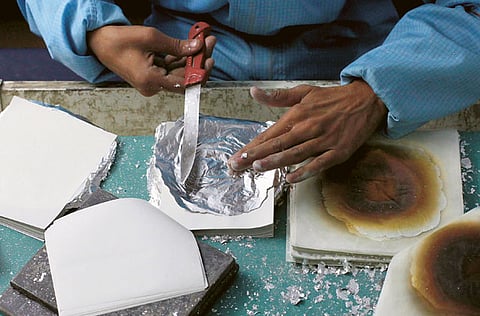
New Delhi: At the Bengali Sweet House in the centre of New Delhi business is brisk, with its silver-covered multi-coloured ‘barfi' sweets, an indispensable treat for sweet-toothed Indians.
But co-owner Girish Aggarwal admits the silver is thinner than it used to be, as the snack restaurant tries to maintain profits in the face of soaring prices for the metal.
"We used to put five silver leaves on a batch, now we are putting on four," says Aggarwal, as he sits in front of the cash register in the white-tiled dining room.
Silver prices, which averaged under Rs18,000 (Dh1,284) per kilogram in the five years to 2009, hit a peak of Rs73,600 in April, and futures still trade around Rs53,000.
Demand for silver in marginal uses such as leaf, embroidery thread and traditional mirrors is highly price sensitive, said Gargi Shah, metals analyst with research company GFMS, a unit of ThomsonReuters.
The two sectors — both pretty much unique to India — account for about ten per cent of the country's industrial fabrication, which totalled 1,979 tonnes in 2010, GFMS said in its World Silver Survey 2011.
"For example, sweets have a relatively low price point of say Rs200 per kilogam on average, but today just one gramme of silver costs Rs50, which is a fourth of the total retail price point, and hence unviable," Shah said.
In the five years from 2005 to 2010, demand for silver leaf fell 23 per cent while consumption for use in silver jari, or thread, for embroidering on saris and weaving, slid 40 per cent, according to GFMS.
India, the world's largest importer of silver, bought 3,029 tonnes in 2010, double the year earlier after a weak monsoon cut demand in 2009 — though purchases are volatile and depend a great deal on price.
"As long as the price of silver moves northwards, it will affect the use of silver in these [margina] applications," Shah says.
Higher prices are prompting some innovative measures to extend the use of silver by mixing with cheaper metals like copper and aluminium, or simply spreading its use more thinly.
Finer than human hair
Tushar Agarwal, the manager of a wholesaler of foils in Mumbai's busy Zaveri Bazaar, says sweet makers' use of aluminium has helped bring his foil business almost to a standstill.
In a glass-fronted building in east Delhi that looks more like a shopping mall than a factory, the walls are sound-proofed against the pounding of machines which take eight hours to flatten a 20 millimetre square of silver to 160 millimetres and just 0.2 microns thick — much finer than human hair.
For 150 sheets, sweetmakers pay Rs450.
Owner Piyush Singh says in some parts of India, aluminium is used in the leaf to reduce costs but he works with pure silver.
"We are not making much margin, in fact you could say we are at breakeven only," said Singh.
Aggarwal, whose father Bhim Sain founded the Sweet House a decade before India won independence from the British in 1947, says silver leaf on sweets is irreplaceable, even if it is expensive.
"It's like lipstick for a lady. If you don't have lipstick, you don't look beautiful," he said.
Cutting the cloth to fit
On the top floor of a three-storey shop in Delhi's Lajpat Nagar market, Mohit Gupta points to the tiny gold threads showing on the back of an opulent gold, silver and magenta fabric that prove it is hand-woven. "Prices have increased 15-20 per cent over seven to eight months," he says. "Sales are down 10-15 per cent."
Gupta, standing out against the peacock blues and jade green silks racked up behind him, says he doesn't see any pick-up in demand while prices are high.
"I think it will be stagnant for a while, people are still waiting for reasonable prices or a fall, which isn't possible at the moment," he said.
A metre of the finest hand-woven silk can cost more than Rs3,000 and it takes five-and-a-half metres for one sari — putting the cost of the fabric alone at a top-end monthly salary for one of Delhi's many chauffeurs of the middle classes.
"People who used to buy ten metres are now buying 8-9 metres. You can't change the amount for a sari but maybe they will cut back on the metres for a dress instead," Gupta says.
"Clothes, jewellery and food are the most important parts of a wedding and they have all increased in cost," he added.
One way to bring down the cost of material for wedding saris is to coat copper or aluminum thread with silver, giving a similar effect but at a much cheaper price.
"A sari with silver work would cost Rs45,000 to Rs50,000 but if we mix aluminum with silver, the cost would come down to about Rs25,000," said Sayyed Mehtab Akhtar Rizvi, an artisan from Mumbai.


