Borrowing costs soar as India fails to win oil deals
Country’s explorers lag behind china in energy hunt
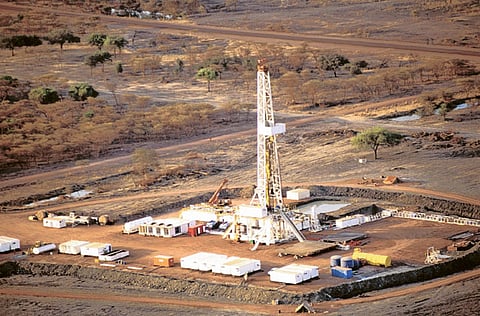
Mumbai: India's failure to secure oil supplies for the world's second fastest-growing major economy has caused relative borrowing costs for its exploration companies to double.
Yields on nine-year bonds of ONGC Videsh, the overseas unit of India's biggest explorer, have risen to 128 basis points more than government debt of similar maturity from 29 basis points four months ago.
Spreads for the debt due in 2020 of billionaire Mukesh Ambani's Reliance Industries widened to 130 from 48. That for Chevron Corp due in 2019 fell to 37 basis points from 104.
Falling output
Faced with declining output at its oil fields, India's government asked explorers to buy at least one "big" overseas asset each year to meet demand. While India has made $946 million (Dh3.47 billion) of oil and gas field purchases abroad in the past year, China has lined up deals valued at $39 billion, according to data compiled by Bloomberg.
"Every time China buys something in Africa, I think, ‘Why hasn't India done it yet?'," Taina Erajuuri, a fund manager in Helsinki at FIM Asset Management that manages $1.2 billion of emerging-market investments, said in an interview on April 7. "There really is a fear factor that India hasn't done much to acquire assets abroad and it's something that needs to be addressed now."
ONGC lost a bid last month to buy ExxonMobil Corp's 25 per cent stake in an Angolan oil field, while Reliance's interest in buying Atlas Energy Inc was thwarted by Chevron in February. ONGC's 2020 bonds yield 9.23 per cent, compared with 5.16 per cent on PetroChina Co's 2017 debt and 3.58 per cent on notes issued by Chevron.
Relative yields on ONGC's 2020 bond reached an 11-month high of 107 basis points, or 1.07 percentage points, on March 25, a day after the government's auditor said the company lost Rs11.8 billion ($267 million) over a 15-month period due to lower production at its Russian fields operated by unit Imperial Energy Corp.
Output at ONGC's Mumbai High fields off India's west coast, which account for 43 per cent of the nation's oil production, declined 6.1 per cent to 1.28 million tonnes in February.
The difference in yields between Reliance's nine-year note and government bonds touched 113 basis points on March 24, the most since May. India's largest listed company may fall short of a goal to produce 80 million cubic metres of gas a day by 2012 from the field, S.K. Srivastava, director general at the Directorate General of Hydrocarbons, told reporters on March 28.
Default swaps
The cost of protecting the debt of Reliance using credit-default swaps dropped nine basis points in the past month to 148 basis points, lagging behind declines of 30 for ICICI Bank and 19 for State Bank of India, the nation's biggest lenders.
The contracts pay the buyer face value for the underlying securities should a borrower breach its debt agreements. A basis point equals $1,000 annually on a contract protecting $10 million of debt.
Investors are concerned "because Reliance hasn't been able to increase gas production", said Jagdish Meghnani, an oil-and- gas analyst at Mumbai-based Alchemy Share & Stock Brokers. "It is the only private company in India that has the strength to go in for big-bang energy acquisitions."
Rising borrowing costs threaten to hamper Indian companies' quest to acquire overseas assets. A joint offer by ONGC, Indian Oil Corp and Oil India Ltd. to buy a 33 per cent stake in London-based Tullow Oil Plc's Ugandan exploration interests failed as the consortium was outbid by CNOOC, the Hong Kong-listed unit of China's biggest offshore oil and gas explorer, a person familiar with the matter told Bloomberg in June. CNOOC said March 30 it signed an agreement with Tullow for the deal.
ONGC offered about $2 billion for the stake in ExxonMobil's Angolan oil field, a person with knowledge of the matter told Bloomberg on March 14. Oil Minister S. Jaipal Reddy was "busy" when asked for comment, his secretary said on April 8.
"China has been much more successful in acquiring overseas assets because its companies have more autonomy, stronger cash flows and the ability to quickly raise low-cost funds," Neil Beveridge, a Hong Kong-based senior oil-and-gas analyst at brokerage Sanford C. Bernstein & Co Inc, said in an April 7 interview.
Future worries: Raising the stakes
- 9.2% yield for ONGC's 2020 bonds
- 80m cubic metres a day gas output for Reliance


