Bernanke may have to overcome Fed split on maintaining stimulus
Stocks, treasuries down on speculation over tightening policy
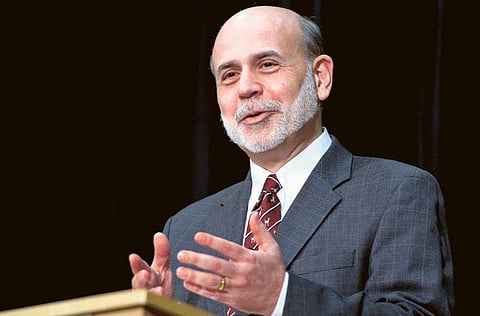
Washington: Federal Reserve Chairman Ben Bernanke may have to overcome divisions among policymakers should he seek to maintain record stimulus past June, minutes of the Fed's March 15 meeting indicate.
A "few" among the central bank's 17 governors and regional bank presidents said tighter credit may be warranted this year, while a "few others noted that exceptional policy accommodation could be appropriate beyond 2011," the Federal Open Market Committee said in the minutes, released on Tuesday in Washington.
Stocks and Treasuries fell on speculation the Fed may start to tighten policy sooner than previously forecast after it completes its $600 billion (Dh2.2 trillion) bond-purchase program in June. A mixed bag of economic indicators, including higher food and energy prices and a slowing expansion in service industries, make Bernanke's job tougher, said Keith Hembre, a former Fed researcher.
Complicated picture
"You've got lower-than-desired growth and the potential for higher-than-desired inflation here, and it definitely complicates the picture from a policy standpoint," said Hembre, chief economist and investment strategist in Minneapolis at Nuveen Asset Management, which oversees about $197 billion.
Several FOMC members "indicated, in light of recent developments, that the risks to their forecasts of inflation had shifted somewhat to the upside," the minutes said.
Since the March FOMC meeting, reports showed the labour market and inflation have picked up while consumer confidence slipped and new home sales dropped to a record low. Some regional Fed presidents who were sceptical of stimulus have talked about the need to tighten credit, and Bernanke has yet to indicate his preference for the Fed's next move.
Even with the division, Bernanke and his top deputies, Vice Chairman Janet Yellen and New York Fed President William Dudley, are unlikely to favour tighter policy this year, Hembre said. "They're the leadership," Hembre said. "They'll dominate the debate and they'll win."
While the decision last month to continue the bond purchases was unanimous, the Fed said a few of the ten voting members of the committee thought evidence of a stronger recovery, higher inflation and rising inflation expectations "could make it appropriate to reduce the pace or overall size of the purchase programme," the minutes said. "Several others" said they "did not anticipate making adjustments."
US stocks erased gains following the release of the minutes. The Standard & Poor's 500 Index was little changed at 1,332.63 at the close of trading in New York on Tuesday after rising as much as 0.4 per cent before the Fed report. The yield on the ten-year Treasury note climbed to 3.48 per cent from 3.42 per cent the day before.
In releases since the Fed meeting, the Commerce Department reported that the central bank's preferred price measure, which excludes food and fuel, was up 0.9 per cent from a year earlier in February, the most since October. Including all items, prices rose 1.6 per cent, compared with a 1.2 per cent 12-month increase through January, the biggest monthly increase since December 2009.
Risks shifted
Several FOMC members "indicated, in light of recent developments, that the risks to their forecasts of inflation had shifted somewhat to the upside," according to the minutes. Bernanke said on Monday in Stone Mountain, Georgia that policymakers must watch inflation "extremely closely" for evidence that rising commodity costs are having more than a temporary impact on consumer prices.
"I don't think we're going to get a fast or abrupt change in policy," said Stephen Stanley, chief economist at Pierpont Securities LLC in Stamford, Connecticut, on Bloomberg Radio's The Hays Advantage.
"But clearly the centre of gravity, I think, is starting to slowly but surely shift to a more hawkish bent as the inflation data start to pick up a little bit," said Stanley, a former Fed researcher, using a term for Fed officials who are more inclined to tighten credit to fight price increases.
The Fed's reluctance to tighten contrasts with some of its counterparts. European Central Bank policy makers have signalled that they may raise their benchmark interest rate from a record low of 1 per cent when they meet today, while China raised borrowing costs yesterday for the fourth time since the global financial crisis to limit the risk of asset price bubbles in the world's fastest-growing major economy.
‘Moderate pace'
Fed staff economists at the meeting gave a forecast for a "moderate pace" of 2011 and 2012 growth similar to projections at the last session in January, while lowering their forecast for the unemployment rate. Even so, "the jobless rate was still expected to decline slowly and to remain elevated at the end of 2012," the minutes said.
Hembre said he reduced his US growth forecast for 2011 to 2.5 per cent from 3 per cent, and for the first quarter to 3 per cent from 3.5 per cent, because "it looks like a fairly weak quarter for domestic demand in spite of the fact that we had a payroll tax cut in the first quarter that boosted disposable income."


