WTO sees export growth slowing
Lamy warns trade protectionism is gaining ground as debt crisis continues Commercial services in second quarter 2011 well down from their peak in third quarter of 2008
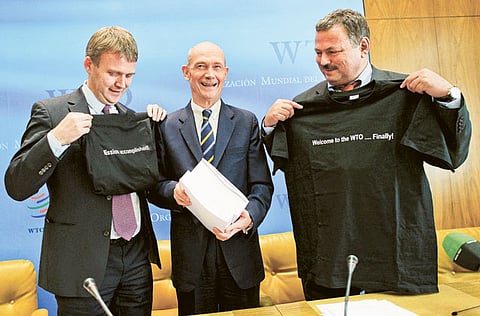
Dubai: The World Trade Organisation (WTO) said yesterday in its annual report that the worsening outlook for the global economy has led to slower growth in exports.
"The outlook for the global economy has worsened considerably in recent months," it said.
"Risks and uncertainties are increasing, after the encouraging signals of recovery seen at the end of 2010. Global activity is slowing down, economic performance continues to be uneven across countries, debt levels and financial volatility are rising, high unemployment levels persist in many countries, and confidence has recently fallen sharply.
"These risks are aggravated by perceptions in markets that governments' responses to these challenges have so far been inadequate," it said.
WTO Director-General Pascal Lamy, told his members: "In a context of greater economic uncertainty and rising global risks, it is all the more important that the process of global trade opening continues."
In light of a worsening of the global economy in recent months, with the forecast for world export growth revised downwards to 5.8 per cent in 2011, he warned that unilateral action to shield domestic industries will not solve global problems but might make things worse by triggering a spiral of tit-for-tat reactions in which every country will lose.
"The contagion from the Eurozone crisis continues to be felt across more and more of Europe," Gary Dugan, chief investment officer, Private Banking, Emirates NBD, said.
Oil
Energy demand and supply in many cases reflect the flow of global trade. This also affects the GCC, the biggest source of global energy.
"Despite fears of a global recession the oil price looks likely to stay high for some time to come," Dugan said.
"Latest estimates from the IEA [International Energy Agency] show that despite the weakness of global growth, the robustness of oil demand from the emerging markets has kept upward pressure on oil prices. The longer term concerns about ongoing strong demand for carbon fuels and limited supply are exemplified by the IEA's estimate that by 2035, China's consumption of energy will be 70 per cent above that of the United States, but still less than 50 per cent of the level of the US per head of population.
"We expect the Brent oil price to remain around $120 (Dh440) level into 2012. In the very near term the oil price was pushed higher by more rhetoric from the United States about the need for tougher sanctions on Iran. Oil stocks have recovered around 20 per cent from their lows in early October. Countries such as India and Turkey that run current account deficits and are large importers of oil will probably see their currencies under continued downward pressure."
Trade
World trade has grown more slowly than expected in recent months, the WTO report said. Developed economies have been hit by a number of problems ranging from shrinking global demand, to the impact of natural disasters, to issues related to national budgets, credit conditions and the sovereign debt crisis.
"Trade growth in developing countries has also been adversely affected by global developments, including signs of overheating in some major emerging markets. In light of the deteriorating economic situation, the forecast for world export growth in 2011 was revised to 5.8 per cent, down from the earlier estimate of 6.5 per cent. Developed economies' exports are expected to rise by 3.7 per cent and those from developing countries by 8.5 per cent," WTO said.
WTO members have been labouring for a decade over further trade liberalisation in the Doha round of talks, with industrialised and developing nations failing to agree on the level of cuts on industrial goods tariffs and agriculture subsidies.
Next moves
Italy and Greece are now being led by experienced bankers and technocrats, and it still remains to be seen if they can fulfil the sky-high expectations placed on them by domestic and international audiences. says Gerhard Schubert, Head of Precious Metals at Emirates NBD.
"The markets stepped back from the danger level of seven per cent in the auctions towards the end of the week, with lower interest rates for Spanish and Italian bonds. This may have been due to continuous buying by the European Central Bank, but it also indicates that the markets might be prepared to see what the next steps by the Eurozone members are going to be," he said.
The report noted a growing perception that trade protectionism is gaining ground in some parts of the world, but said fewer restrictive measures had been introduced in the past year.
While developing countries should continue to see strong trade growth in the coming months, the report warned that, "even the most dynamic developing economies would still find themselves strongly affected by another global recession."
It noted that developing countries had accounted for more than half of the growth in the value of trade since the global economic crisis began.
The economic recovery has so far not been strong enough to reduce significantly high levels of unemployment in many countries. According to the International Labour Organisation (ILO), based on current trends, employment is not projected to return to its 2008 level before 2015 in high-income economies. The number of unemployed stood at 205 million in 2010, essentially unchanged from the year earlier, with little hope of this figure reverting to pre-crisis levels in the near term. The ILO warned recently of a ‘dramatic downturn' in employment over the coming months unless governments act to soften the effect of the economic slowdown on labour markets.
"The world economy is at a critical juncture. The reduced pace of economic growth has left debtor countries more vulnerable to external economic shocks and to missteps by policy-makers," it said.
Signs of revival
"Moreover, there is a growing perception that trade protectionism is gaining ground in some parts of the world as a political reaction to current local economic difficulties — difficulties that trade restrictions are very poorly equipped to resolve. There are various signs of a revival in the use of industrial policy to promote national champions and of import substitution measures to back up that policy."
Nonetheless, new restrictive measures introduced in the period between mid-October 2010 and mid-October 2011 cover around 0.9 per cent of world imports, down from 1.2 per cent recorded in the previous twelve-month period.
Weaker than expected output growth in the first half of the year, combined with the possibility of negative feedback between the real economy and the financial-fiscal crisis, have prompted the IMF to lower its forecast for world output in 2011 to 4.0 per cent down from 4.3 per cent in the spring.
Advanced economies are now expected to grow just 1.6 per cent in 2011 (down from 2.2 per cent), while emerging and developing economies should see an increase of around 6.6 per cent (down from 6.8 per cent). These figures are calculated using purchasing power parity (PPP) exchange rates.
At market exchange rates, the IMF's projection for world GDP growth in 2011 was reduced to three per cent down from 3.4 per cent, with no breakdown provided for developed and developing economies.
Dubai US imports of commercial services in the second quarter of 2011 returned to their pre-crisis level of around $100 billion (Dh367 billion), first reached in 2008, based on WTO data.
Meanwhile, exports rose to their pre-crisis peak of $140 billion in the second quarter of 2010 but have been flat since then. Year-on-year growth in US commercial services trade in the second quarter of 2011 was 12 per cent on the export side and six per cent on the import side, with little change from the previous quarter for either exports or imports.
European Union extra-exports of services were valued at $139 billion in the first quarter of 2011. They have never recovered their pre-crisis peak of $203 billion in third-quarter 2008. Imports of services in second-quarter 2011 were $120 billion, down from their peak of $179 billion in third-quarter 2008.
French and German exports and imports have dipped in US dollar terms in recent months. However, some of these changes may be due to normal seasonal variation, so year-on-year growth rates should be considered.
Japanese exports of services fell sharply in second-quarter 2011, wiping out all gains for the year.


