Jordan to lift subsidy on fuel products as of Tuesday midnight
72 per cent of Jordanians in need of subsidy, said Jordanian foreign minister
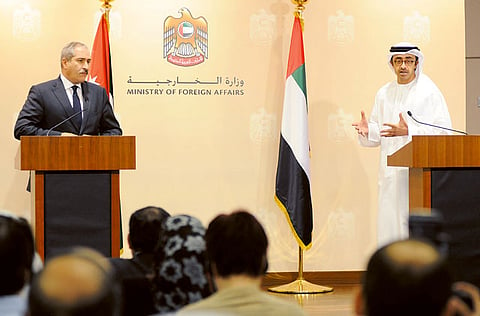
Abu Dhabi: The Jordanian government’s decision to lift subsidies and to sell fuel products at cost has been taken to avoid further financial burdens and losses to the Kingdom’s Treasury, Nasser Judeh, Jordanian Foreign Minister, said in a joint press conference with Shaikh Abdullah Bin Zayed Al Nahyan, UAE Foreign Minister, on Monday.
“We are facing very tough economic conditions not related to government spending plans but rather to the difference of prices in gas and fuel which Jordan imports to generate power,” Judeh said.
Judeh thanked the UAE for its support to Jordan in dealing with the difficult economic conditions it is facing, particularly within the Gulf Cooperation Council’s (GCC) $5 billion (Dh18.36 billion) grant extended to the Kingdom to support development projects over the next five years.
The two officials stressed the importance of agreements and protocols signed by the Joint Jordanian-Emirati Committee which will pave the way for further economic and investment cooperation between the two countries.
Shaikh Abdullah said: “Jordan’s economic hardship was caused because the Kingdom has an agreement with Egypt to buy gas in order to generate power; the pipeline has been damaged many times and this has affected the prices of the gas and heavy fuel the Kingdom purchases to generate power.”
“These hardships would not have been had the gas shipments from Egypt continued to flow via the pipeline to Jordan,” said Shaikh Abdullah.
“We are doing our best to alleviate these hardships together and within the umbrella of the GCC,” said Shaikh Abdullah.
Judeh said that the Jordanian government will offer cash handouts to help Jordan’s poorest residents cope with the 54 per cent increase in cooking gas and 33 per cent rise in diesel and kerosene.
He explained that the new subsidy regime will deliver direct cash support to low and middle-income Jordanians.
“We are subsidising commodities and we should have channelled the subsidy to the right citizens. That is why we are going to apply this measure. About 72 per cent of Jordanians will be given cash handouts and only 28 per cent will not,” he remarked.
As a result of the lift of subsidies, diesel and kerosene prices will increase accordingly as of November 20 midnight.
He further noted that there are 7.5 million people living in Jordan, 1.5 million of whom are not Jordanians but benefit from the blanket subsidy regime.
Those who deserve government support after eliminating the subsidy system are between 3.5 million and 4 million Jordanians, whose families’ annual income is less than $15,000.
The decision to remove fuel subsidies could not be postponed due to the financial and economic situation of Jordan, which he described as very critical, stressing that such a step should have been taken two years ago.
He said that public expenses in this year’s state budget were higher than revenues by Dh15.6 billion.
Judeh explained that the cost of generating power will reach Dh7 billion due to interruptions in gas supplies from Egypt.
Abdullah Ensour, Jordanian prime minister, said earlier that expected increase in oil prices after lifting subsidies would push inflation up by less than 3 per cent.
The decision to lift subsidies and sell fuel products at cost was taken to avoid further financial losses to the Treasury, according to Prime Minister Abdullah Ensour, who estimated the cost of subsidies on this year’s budget at Dh4.4 billion (JD800 million).
Early this month, Judeh was in Kuwait and signed several cooperation agreements in the education, culture, diplomacy and customs sectors. Following his meeting Kuwaiti Emir Shaikh Sabah Al Ahmad Al Sabah, Judeh stressed Jordan’s keenness to maintain the pace of development in relations between the two countries.
In Kuwait, Judeh expressed Jordan’s appreciation of the 1.25 billion Kuwaiti grant, as part of the GCC grant from Saudi Arabia, Qatar, the UAE, and Kuwait.
“We highly appreciate these grants and receiving the Kuwaiti part as the first of the GCC countries,” the foreign minister said.
Judeh added that trade volume between Kuwait and Jordan amounted to $270 million in 2011, which falls well below the expectations of the two countries.
Jordan is interested in improving its investment environment, he said, noting that the Kuwaiti investments in the Kingdom reached $10 billion in 2012.
Each individual of a household that consists of six members or less and whose income is less than 800 Jordanian dinars (Dh4,127) a month or 10,000 dinars a year will receive 70 dinars in compensation for the hike in prices, Ensour said.

