France, Germany press for debt deal
Eurozone ministers discuss second Greece package
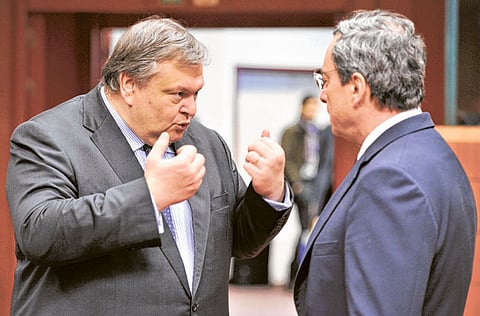
Paris/Berlin: Germany and France yesterday pressed for a rapid deal between Greece and its private creditors that returns its soaring debt to sustainable levels and said they remained committed to a new bailout that is needed by March to avert a disastrous default.
Eurozone finance ministers were due to decide later yesterday what terms of a Greek debt restructuring they are ready to accept as part of a second rescue for Athens.
Ahead of that meeting, French Finance Minister Francois Baroin said an elusive deal to convince the banks and investment funds that own Greek debt to accept deep losses on their holdings appeared to be "taking shape".
But his German counterpart Wolfgang Schaeuble warned that any deal must help Greece cut its debt mountain to "not much more than 120 per cent of GDP" by the end of the decade, from roughly 160 per cent today, something many economists believe will not be achieved by the existing plan.
"The negotiations will be difficult, but we want the second programme for Greece to be implemented in March so that the second tranche can be released," Schaeuble told a news conference in Paris with Baroin and the heads of the German and French central banks.
"Greece must fulfil its commitments, it is difficult and there is already a lot of delay," Schaeuble said.
After several rounds of talks, Greece and its private creditors are converging on a deal in which private bondholders would take a real loss of 65 to 70 per cent on their Greek bonds, officials close to the negotiations say.
But some details of the debt restructuring, which will involve swapping existing Greek bonds for new, longer-term bonds are unresolved.
No room for improvement
Charles Dallara, the Institute of International Finance chief who is negotiating on behalf of the private debt holders, left Athens over the weekend saying banks had no room to improve their offer.
Sources close to the talks told Reuters yesterday that the impasse centred on questions of whether the deal would return Greece's debt mountain, currently over €350 billion (Dh1.6 trillion), to levels that European governments believe are sustainable.
"There will likely be an updated debt sustainability analysis that will be discussed at the Eurogroup," a banking source in Athens said, requesting anonymity. "Talks will continue this week. The aim is to have an agreement by late next Monday."
In Brussels, European Economic and Monetary Affairs Commissioner Olli Rehn said talks had been "moving well" and expressed confidence a deal could be sealed this week. But German Chancellor Angela Merkel said there was no question of extending Greece a bridging loan if talks with the private sector dragged on further. The euro pushed up to its highest level against the dollar in nearly three weeks on hopes for a successful debt swap.
Speaking in Berlin, IMF chief Christine Lagarde urged European governments to increase their financial firewall to prevent Greece's troubles from ensnaring bigger countries like Italy and Spain. She also called on European leaders to complement the "fiscal compact" they agreed last month.

