Eurozone clears 12b euro aid tranche for Greece
Eurozone finance ministers cleared the way for Greece to receive 12b euros
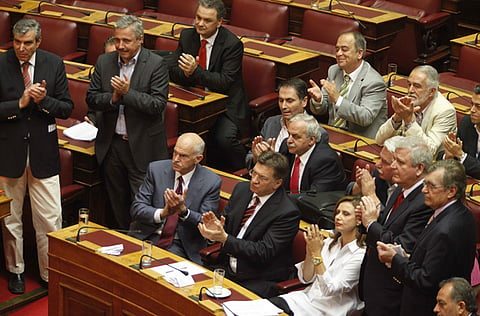
Brussels: Eurozone finance ministers cleared the way Saturday for Greece to receive 12 billion euros in urgent aid by July 15, an official statement said.
The ministers also said they would determine the details of a second bailout for Greece, including the scale of private sector participation, in the "coming weeks."
The ministers signed off their portion of the 12 billion euros ($17.39 billion) loan tranche in a conference call Saturday evening. The International Monetary Fund is expected to approve its part of the loan next week.
The ministers also reiterated that they would continue to support Greece beyond the 110 billion euros loan package that was granted last year, but left a final decision on the new aid plan until the involvement of banks and other private creditors has been figured out.
They said "the precise modalities and scale of private sector involvement and additional funding from official sources will be determined in the coming weeks."
Agreement in principle
Earlier, Eurozone governments reached an agreement in principle on the pay-out Friday after the Greek parliament met EU and IMF demands to pass tough austerity measures despite rioting in the streets of Athens.
The ministers decided to cancel a meeting in Brussels on Sunday and speak by phone instead because nothing is holding up the next tranche, diplomats said. But they need more time to negotiate a second bailout for Greece.
"Since things are moving forward on the fifth tranche, which is good news and a breath of fresh air, and that work on (the new bailout) is not ready for Sunday, we preferred to have a conference call," a European diplomat said.
Greece desperately needs the 12 billion euros this month to avoid an immediate default on its debt.
Analysts warn that such a default could spill over to other eurozone nations such as Ireland and Portugal, and even Spain and Italy.
But Athens has requested a new rescue package that Prime Minister George Papandreou says could be as big as the first one.
"We can't afford to relax and we need to move forward as fast as possible, both on the eurozone and IMF side," Polish Finance Minister Jacek Rostowski, whose country took over the rotating EU presidency, said Saturday.
Lasting solution
Amid fears a Greek default could ripple across the financial world, the United States has pressed Europe to find a lasting solution to the debt crisis.
"It is our hope that European leaders continue to make sure that Europe's response to the crisis is strong, flexible and effective," US Secretary of State Hillary Clinton said during a visit to Madrid on Saturday.
Talks on a second bailout are tricky because some governments, especially Germany, want private investors to share the pain by agreeing to a voluntary rollover of Greek debt. Under the scheme they would buy new bonds to replace those maturing soon.
Their plan won the backing Friday of a key global finance group, the Institute of International Finance (IIF), which represents banks, insurers and investment funds.
"The private financial community is ready to engage in a voluntary, cooperative, transparent and broad-based effort to support Greece given its unique and exceptional circumstances," the Washington-based IIF said.
Diplomats said a decision on the size of the new bailout, and the participation of private investors, could come at another meeting in Brussels on July 11, or up to two months later.
"The programme must be sealed as soon as possible, but we can't rule out that its conclusion be put off to September," a diplomat said.
Another diplomat said it was better to proceed cautiously because speed is "the enemy of a thorough decision."
Since the eurozone wants to avoid any scheme that would be interpreted as a default, governments are holding talks with the world's powerful credit ratings agencies to determine how they would view the deal, the diplomat said.
France, whose banks hold a sizeable proportion of Greek debt, has proposed, among other measures, that lenders roll over their loans into new 30-year bonds, giving Greece more time to put its financial house in order.
German banks made a gesture Thursday by agreeing to extend the maturities of around 3.2 billion euros ($4.6 billion) in Greek bonds due to expire between now and 2014.


