Cameron urges EU to replace Doha talks with bilateral pacts
Critics say these deals would distort global economic efficiency
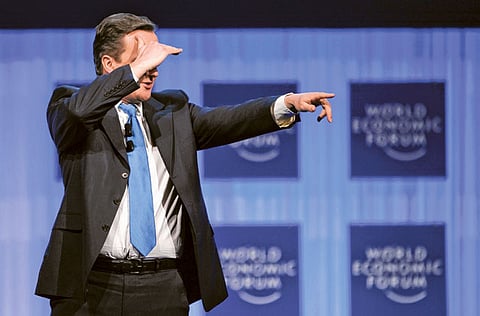
London: British Prime Minister David Cameron yesterday called for Europe to bypass the Doha talks on a world free trade deal in favour of seeking separate agreements with the United States, Africa and other willing parties.
Cameron's comments at the World Economic Forum in Davos break with the orthodox position of most world leaders who have, for years, called for a final push to conclude the complex trade negotiations, which were launched in the Qatari capital in 2001.
But, they also reflect a growing recognition among European officials that the talks have stalled for the foreseeable future because of sticking points over proposals to cut tariffs and subsidies on goods ranging from food to chemicals.
Instead of trying to get every country to agree, Cameron said the 27-nation EU should push forward with bilateral deals. He suggested a "coalition of the willing" — countries that wanted to do an ambitious trade deal — could forge ahead alone.
"Last year, at this forum, world leaders called for an all-out effort to conclude the Doha round in 2011. We said it was the make-or-break year. It was. And we have to be frank about it. It didn't work," Cameron said. "But, let's not give up on free trade. Let's step forward with new and ambitious ideas to take trade forward."
Fears of protectionism
Leaders called for a new push on Doha after the 2008 financial crash, concerned that countries would be tempted to close off their economies to protect key sectors buffetted by the global turmoil.
Cameron's impatience reflects Britain and Europe's need to seek growth in foreign markets to offset the impact of budget cuts which have driven their economies to the brink of recession at the start of 2012.
German Chancellor Angela Merkel told Davos on Wednesday that one of the pessimistic signs of the last year was the failure to conclude the Doha talks and signs of a return of protectionism. "Because we are having such a hard time making progress with the Doha round, the EU (is) working on bilateral trade agreements with (South) Korea, which has been concluded, and working on one with Japan," she said. "With the United States, we have a lot of possibility to achieve a free trade zone."
US-EU free trade deal
A joint letter by the French and German finance ministers preparing for next Monday's EU summit, seen by Reuters, calls for the negotiation of a US-European free trade agreement covering a wide range of goods, services and trade facilitation.
The Doha talks were intended to help poor countries prosper through trade and boost the world economy by hundreds of billions of dollars. Nobel Prize-winning economist Joseph Stiglitz warned individual deals carried more risks for developing economies.
"These bilateral deals undermine the multilateral system and distort global economic efficiency. They tend to be more unfair because the bargaining is more unbalanced," he said.
Cameron urged the Eur-opean Union to wrap up talks on free trade agreements with India, Canada and Singapore by the end of this year. "Completing these could add €90 billion (Dh434.5 billion) to EU gross domestic product," he said. "Let's also look at options for agreement between the EU and the US, where a deal could have a bigger impact than all of the other agreements put together."
Negotiating a US-EU free trade agreement is a long-held British dream. The then EU Trade Commissioner, Leon Brittan, now a trade adviser to Cameron, suggested a similar idea in 1998, but it was shot down by France, which feared the European Union could be forced into concessions on farm trade.
CURRENCY WAR
European exporters are benefitting from a 20-30 per cent fall in the value of the pound and the euro against the dollar over the past three years which should make their companies more competitive overseas.
But, the efforts of big emerging economies like China and Brazil to hold down the value of their own currencies reflect the risk of a new era of protectionism, which economists warn could cripple efforts to put world growth back on its feet.
"The worst thing that could happen now is ...protectionism," Pascal Lamy, who overseas the Doha talks as head of the World Trade Organisation, said.

