Onboard South America’s first luxury sleeper train
Michael Kerr joins the inaugural journey of South America’s first luxury sleeper train to the shores of Lake Titicaca
The condor, that avian wonder of the Andes, can soar to 16,000ft, go five weeks without eating and, when it does alight on carrion, gobble around 5kilos of meat.
On the pre-inaugural run last month of South America’s first luxury sleeper train, the Belmond Andean Explorer, we didn’t quite reach those heights - at La Raya, between Puno and Cusco, we slept at 14,253ft and woke to snow on the ground as well as on the peaks. But then we didn’t have to work up an appetite, either. At every stage in our journey, from Arequipa, a city guarded by three volcanoes, to Cusco, former capital of the Inca empire, we were fed and watered well. Like the condors, we gained post-prandial pounds. We were also left breathless.
The landscape of Peru does that to you - not just metaphorically, as in the cliche, but literally. Soroche, that mysterious altitude sickness that can lay low an Olympic athlete and spare a couch potato, claimed a few victims; the train’s doctor wasn’t entirely idle. And Peru, which many of our party were seeing for the first time, claimed yet more hearts.
Belmond (formerly Orient Express Hotels) has been a player in tourism here since 1999, when the company’s founder, James Sherwood - the man behind the Venice Simplon-Orient-Express - was invited to become an investor. Having started with the Sanctuary Lodge at Machu Picchu and the luxury day train that runs to it, the Hiram Bingham, Belmond has built up a portfolio of six hotels.
The latest was acquired (or, rather, reacquired, for the company owned it in the Nineties) just before our visit.
So it was that, following an evening arrival in Lima and a morning flight to Arequipa, we set out not on the rails but on the road, heading for Las Casitas del Colca, a complex of rustic bungalows on the edge of the Colca Canyon, which, at 62 miles long and 2,112ft at its deepest, makes its counterpart in Arizona look a little less grand.
To reach it, we travelled for six hours through a landscape of soaring peaks and plunging gorges; a landscape that bears witness to the shifting by nature of tectonic plates and the sculpting by man of terraced fields. The oldest of the latter were producing potatoes and corn in AD200. From Las Casitas we set out the following morning for the Cruz del Condor, a cross marking a point where the birds often rise on the thermals. Roberto Alayza, our lean and learned guide, had briefed us on the differences between males and females, so I could probably have discerned them through binoculars had I been bothered to squint. I didn’t: it was enough to marvel that a bird weighing up to 24lb was soaring both above our heads and, in the canyon, beneath our feet.
Then it was on to another viewpoint, one we Belmond customers had pretty much to ourselves. Chairs were placed yards from the edge, while chefs in immaculate whites set up tables to serve us wraps of stir-fried beef or chicken with yellow-chilli sauce, followed by pear tatin. An edgy breakfast wasn’t their only trick. They dug our lunch out of the ground.
On a eucalyptus-shaded lawn at Las Casitas, they introduced us to the Peruvian traditions of the huatia and the pachamanca. The former is a hole in the earth, topped with rocks and leaves in a dome where a fire is kindled. The latter is the dish cooked inside - this time chicken, lamb and other meats with corn and potatoes. If it looked grubby, it tasted surprisingly good.
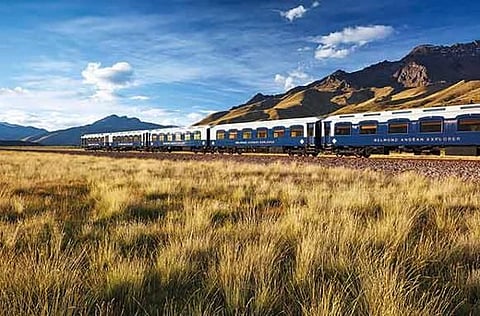
On our third day, we finally saw the train, its carriages of midnight-blue and ivory (as the Belmond designers have it) gleaming above the ichu grass at the station of Tambo Canahuas, near a spot where the winds, racing across a plain, come up against a rock face and carve it into the shape of wigwams.
The carriages had already been on quite a journey. They were built for the Great South Pacific Express, which ran from 1999 to 2003 between Sydney and Kuranda, close to Cairns. Belmond had them shipped across the Pacific - along with crystal chandeliers, crockery and a baby grand piano - for restoration and redesign in the Cusco workshops of Peru Rail.
After words of welcome from Belmond’s managing director for Peru, Laurent Carrasset, the train was blessed by two Franciscan priests in brown robes, who are clearly used to handling the media. The elder, who’d had several cameras shoved in his face while saying the prayers, began his dispensing of holy water with a good splash on the offenders’ lenses. And then we were off.
The vicuna, the most skittish of Peru’s camelid family, can be hitting nearly 20mph 45 minutes after birth. The train - hauled by a Canadian-built 1970s diesel of Peru Rail - was sometimes a tiny bit slower. That speed was necessitated by frequent bends, which enabled photographers in the observation car at the rear to capture great images of the front. Meanwhile, others were examining cabins and communal rooms.
It’s hard to believe the carriages were built in the Nineties, for they have detailing that recalls the Twenties or Thirties: art nouveau-style ceilings; mahogany panelling stained the colour of ivory; marquetry work on bathroom floors with a fleur-de-lis pattern; intricate grilles over the air-con vents, made of brass but now finished the colour of chrome.
Carriages are named after the local flora and fauna. My cabin (one with a double bed rather than bunk) was Chilca - named after a plant that yields a textile dye, basket material and an anti-inflammatory medicine.
In the decor, one constant is the chakana cross, a three-stepped symbol that dates from Inca times and represents the heavens, the earth and the underworld. It’s emblazoned on the outside of the carriages, on the jackets worn by guides, on napkins and glasses on tables and on the bathrobes and towels in the cabins.
We had been told that the globe-trotting Diego Munoz, one of Peru’s most gifted chefs, would be showing us how to prepare ceviche, that appetiser of raw fish marinated in salt, lime juice, onions and chilli. We hadn’t been told that he would be doing it outdoors, the train at his back, lakes and mountains to the front.
‘My grandmother would let it sit all night,’ he told us as the rain spat; we voted to stay outside. ‘Then the Japanese came over and taught us how to eat it straight away.’ And that, when his demo was over, is exactly what we did. He and his team, working in a kitchen measuring about 50ft by 8ft, produced dishes that not only made the most of Peruvian produce but even seemed to conjure the landscape.
His presentation on the last night of potato cream, seared scallops and parmesan put me strongly in mind of an island floating on Lake Titicaca. After Machu Picchu, where Belmond’s other Peruvian train runs, the world’s highest navigable lake is a place every visitor wants to see. There is, as the map on our boat from Puno station acknowledged, a well-worn ‘Circuito Turistico de Lago Titikaka’. We didn’t deviate from it.
Our boat took us to the Islas Uros, a floating world made possible by totora reed. The reed can be used to build islands, houses on those islands, boats to sail around those islands, and - when there isn’t a Diego Munoz available - can even provide a snack.
In ancient times, these people lived off fishing and hunting; nowadays they catch tourists. What set our outing on Titicaca apart from the average was the way it ended.
First, we stepped off the boat to be met on the quayside with some beverages, a blazing fire and the playing of Pallari and Manuel, a duo who provided soothing sounds on sax and acoustic guitar.
Then, after a final dinner, we were invited to the bar car, where Cheguere, a Cusco trio of guitarist, bassist and percussionist, urged us not just to sit talking about the train but to dance on it. Some carousers kept the staff up until after two in the morning.
I was impressed by the warmth and professionalism of the staff. Several had previously worked on the day train between Cusco and Puno - an Andean Explorer without Belmond branding - that was originally to be withdrawn when the new sleeper came into service but will now continue under another name.
Their new train wasn’t without its teething problems, at least some of which should have been fixed by the time the first paying customers boarded. Among them was faulty plumbing. On my first morning, I had to shower in cold water. On my second, I turned on the taps and had neither hot nor cold. The key I was given would turn the lock but couldn’t be pulled out of it. The air conditioning - which you can’t adjust yourself - was at first so fierce that I woke with a dry throat. The notes on the in-room ‘directory’ included a map that showed where Wi-Fi would be at its strongest. In my experience it wasn’t weak; it was simply unavailable. But then the point of a journey like this is not to maintain connections with the workaday world; it’s to slip those bounds and, for as long as you can, enter one of fantasy.
The real trouble, for those of us lucky enough to have travelled on a luxury sleeper train at altitude, was that eventually we had to come back down to earth.
THE TRAIN IN NUMBERS
■ 10,000,000 Cost, in $, of getting the Belmond Andean Explorer up and running
■ 55 Staff on board
■ 48 Passengers
■ 106 Length of the train, in feet
■ 24 En-suite cabins (two deluxe double, six junior double, 11 twin, five bunk-bed), including one that is wheelchair-accessible
■ 2 Dining cars (Llama and Muna) 1 Spa car (Picoflor), to be added later
■ 1 Observation car (Ichu)
■ 1 Piano bar (Maca)


