The brand value of India's heritage
Treasured as living legacy, tradition and craft, India’s jewellery and textile sectors are inching towards corporatisation
Most people who grew up in India have been fed a steady diet of legends about its textile and jewellery heritage. We hear of the Nizam of Hyderabad who used a Golconda diamond as a paperweight, of Jamdani muslin sarees made of material so fine that all six yards of it could pass through a ring, and Kannagi’s gold anklets stuffed with gemstones that revealed themselves only when the anklets shattered.
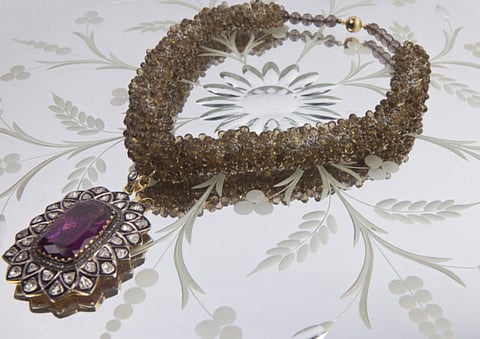
Jewellery is a necessary sort of preoccupation in a country where the consumption of gold and jewellery has grown at the rate of 10 to 15 per cent per year. The domestic market is estimated to be more than $30 billion (about Dh110.18 billion). Gems and jewellery make up about 14 per cent of India’s total exports, and the sector employs about 3.4 million workers. Some of them are skilled in the traditional crafts, and create luxurious pieces such as kundan meena ornaments, the backs of which tell intricate stories in colourful enamel, even as the fronts glimmer translucently in white and gold.
Just like language changes every few kilometres in India, textiles are as much a part of the cultural vocabulary. Cashmere, Kota, Chanderi and Kanchipuram are names for both textiles and for the places that they come from, sustaining large numbers of people.
Revival of interest
“The techniques that Indian craftsmen use have endured,” says Dr Usha BalaKrishnan, jewellery historian and the author of books such as Dance of the Peacock and Jewels of the Nizam. “Indian styles of enamelling and pachchikam, which is setting gemstones in metal compartments, and kundan, where thin ribbons of gold are used to encase the gemstone, are technically different from the West.
“In recent years there has been a revival of demand for handcrafted ornaments. Most large jewellers operate on two levels — they create die-cast pieces for mass consumption; at the same time customers willing to pay the premium required can enjoy exclusive commission-based, one-of-a-kind pieces.”
New focus
From the government, the most recent initiative is a cotton report commissioned by the Cotton Textile Export Promotion Council (TEXPORIL), to create a road map for increasing textile exports from India and build confidence among lenders and investors.
The report, titled Cost Benchmarking Study-India vis-à-vis Bangladesh, Indonesia, Egypt, China, Pakistan and Turkey, examines everything from cost factors such as wages, power, water, transport and exchange rates to the competitiveness of the textile industry in India and these countries.
In the jewellery sector, the All India Gems and Jewellery Trade Federation, which was set up in 2005, is working with the government on a ten-year plan. “We are 20 directors from around the country trying to reskill people through a curriculum that we are developing,” says C Vinod Hayagriv, Managing Director of Bengaluru-based jewellery company, C Krishniah Chetty and Sons. “The goal is to provide skills to about 75,000 people in five years, by creating minimum standards of training, skill and certification in every field, including handcrafting, casting, diamond cutting, retail and sales.”
Word-of-mouth, skill of hand
Lack of documentation and labelling are among the biggest challenges for both sectors. Historical records work as a bridge between generations, making people aware of the fine print in the legend. Unfortunately, for most Indians, unless they are directly involved in the craft, information is hard to come by. Weavers, traders and Wikipedia can tell us, for instance, that the kota fabric, famed for its gossamer lightness, uses silk as well as cotton threads. In jewellery, it’s common for goldsmiths to pass off die-struck pieces as handmade.
“Purity has been a major concern due to the lack of labelling,” says Mehra. “It is not mandatory by law to display on a fabric what the contents are. If you look at high-end shawls in India, the retailer will often decide the price after ascertaining how much the consumer can pay. There is no labelling for authenticity, fibre content or pricing. So in case of cashmere or pashmina, which is made from a specific type of wool, the consumer can end up with a shawl made of polyester, bleached wool or silk.”
Dr BalaKrishnan says not branding art forms is also a tradition of sorts. “There is even a debate on who the architect of the Taj Mahal was. In the case of miniature paintings executed for Mughal emperors, only in recent years have some scholars begun to trace little signatures and started identifying them by technique.”
She compares Indian jewellery majors’ lack of documentation with their international counterparts. “Paris-based jeweller Cartier, for instance, signed and numbered their pieces and preserved records of commissions and designs. In India, when it comes to records, sometimes in inventories of royal jewellery you come across mentions of ten necklaces or five sarpech (a turban ornament) or 20 armbands. These are valuable but don’t tell you the weight of each piece or the stones used.”


