The Kurator’s Frieze London roundup: In and around the fair
UAE, regional galleries brought bold artworks, fresh talent and historic names to London
Every October, London’s art world pitches two tents in a royal park and spends five days browsing, gossiping and politely not asking the price. Frieze London is the tent for living artists and new work, with 176 galleries this year. Frieze Masters, next door with 142, covers everything older, from antiquities to the twentieth century. Each gallery gets a booth, a white-walled stand that dresses like a pocket-sized exhibition.
This year 95,000 people came, from 108 countries and regions, including delegates from a record 426 institutions. Frieze said visitors from the UAE were up last year, and dealers reported growing demand from collectors across West Asia and North Africa. Here is who brought the Gulf and the wider Arab world to the party, in the tents and around them.
The first tent: Frieze London
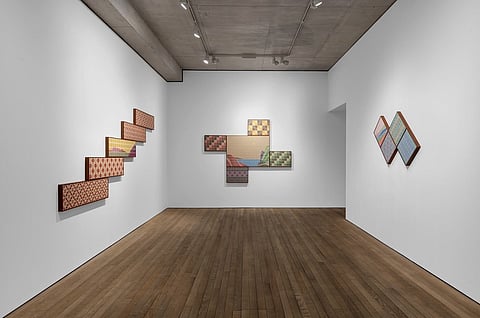
Carbon 12 of Dubai brought Sarah Almehairi, born in Abu Dhabi in 1998 and still working there. Her Off Centric & Off Centered series takes grids, lines and architectural structures and cuts, folds and rearranges them, so the empty gaps carry as much weight as the solid shapes. Sharing the stand was the Syrian-Canadian painter Nour Malas, who paints from dreams and family ties, above all the bond between three generations of women in her family.
Hafez Gallery of Jeddah made its Frieze London debut, the art-fair equivalent of a first day at a new school. Its presentation, Dialogue of Forms, put the Egyptian artist Ahmed Nawar beside the Bahrain-born Saudi artist Faisal Samra. Nawar fills paper with dense black-and-white felt-tip geometry and human figures in his Irada Watan series. Samra hangs translucent wire-mesh and fabric sculptures in the air, where they shift with the light and with whoever walks past. Both artists are in the collections of the British Museum and Mathaf: Arab Museum of Modern Art.
Athr, which has spaces in Jeddah, AlUla and Riyadh, took a stand in both tents, and sold Ahmed Mater’s Gun Gas (2026) for around £40,000. Selma Feriani (Tunis, London) came with new work by Zineb Sedira, Maha Malluh, Monia Ben Hamouda, Filwa Nazer and Catalina Swinburn.
Also in the main tent: Gypsum from Cairo, Sfeir-Semler (Beirut and Hamburg) and Dastan (Tehran and Toronto). Beirut’s Marfa’ returned in Focus, the section for galleries founded in the last twelve years.
The second tent: Frieze Masters
Frieze Masters is the history tent, and the region has plenty of history to show. Athr, a newcomer here, paired Mounirah Mosly with Abdulrahman AlSoliman. In 1973 Mosly became the first Saudi woman to hold solo exhibitions in Jeddah and Riyadh, and she works in etching and mixed media on papyrus. AlSoliman’s abstract painting spans five decades.
Two Dubai galleries, Lawrie Shabibi and the first-timer Gallery Isabelle, were also in. Lawrie Shabibi showed Maliheh Afnan, and Elmarsa Gallery showed Mahjoub Ben Bella, both in Spotlight, the curated section of solo shows by pioneering twentieth-century artists.
Meanwhile, outside the tent
Frieze also runs its own gallery in Mayfair, No.9 Cork Street, which turned five this month. Dubai’s The Third Line marked it with Jordan Nassar’s No History of Shapes / لا تاريخ للأشكال, its first show there. Nassar works from tatreez, the cross-stitch embroidery of Palestinian dress, where each village has its own motifs. His new embroideries and mosaics recontextualise those traditions, and the show runs to 24 October.
At Tate Modern, the Beirut-born, Paris-based sound artist Tarek Atoui has filled the vast Turbine Hall with instruments instead of a single big object. A metal karnai, a ceremonial brass trumpet from Uzbekistan, hangs over the ramp. Drum skins, gongs and 20-metre textiles hang among bamboo and sheng mouth organs, and a computer-controlled motor pushes air through the lot, so the building’s own air currents help play it. Hold runs from 13 October to 11 April 2027, with free live performances on selected Friday evenings, the next on 13 and 27 November.
At Whitechapel Gallery, Inji Efflatoun: The Poetics of Justice is the first significant UK exhibition of the Egyptian painter, feminist and political dissident (1924–1989). She was jailed from 1959 to 1964 and kept painting throughout, and those works are in the show. It is presented in partnership with the Sharjah Art Museum and runs until 14 February 2027.
Off the map
Two more stops are worth your time, though neither is strictly Arab. Leila Heller Gallery, which has spaces in Dubai and New York, showed Douglas White’s Black Palm (2026) at Frieze Sculpture, the free outdoor show in the park’s English Gardens that runs until 1 November. The sculpture stands more than seven metres tall and is built from discarded truck tyres and steel, gathered by the London-based artist along highways in Belize. The Gulf link here is the gallery.
The New Delhi designer Vikram Goyal is from India, so he is off our map, but a first London solo show a few streets from the fairs earns a place. Wings and Tales, at 7 Grafton Street from 12 to 16 October, filled two rooms of a Georgian townhouse and took the Indian baithak, or drawing room, as its theme. Animals from the Ramayana moved in: a vulture spread across a textile screen, an embroidered monkey on a stool, gold claws peeking out from under an ottoman. The brass is repoussé, hammered into relief from the back before the front is refined. It ran alongside PAD London, the design fair in Berkeley Square.


