Al Jaber calls for united efforts
Masdar chief tells meeting nations should chart joint path in climate fight
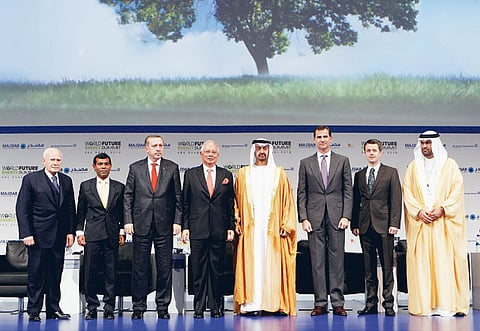
Abu Dhabi: Countries of the world will have to come together to ward off threats of climate change through their commitment to cleaner, renewable sources of energy, Dr Sultan Al Jaber, chief executive of Masdar (Abu Dhabi Future Energy Company), said here yesterday in his inaugural speech at the World Future Energy Summit 2010.
"We cannot afford to falter ... we have to develop clean energy solutions and drive progress towards low carbon economy," Al Jaber said in the presence of General Shaikh Mohammad Bin Zayed Al Nahyan, Abu Dhabi Crown Prince and Deputy Supreme Commander of the UAE Armed Forces, and other delegates at the summit.
The third edition of the annual summit, being attended by some heads of state and government, will over the next three days seek solutions to the threat the world faces from global warming.
Al Jaber said through its Masdar Initiative, Abu Dhabi wants to promote global cooperation and dialogue in renewables and "push renewable energy to a new frontier".
In this regard, he called for greater collaboration between the public and private sectors.
He said global investments in renewable energy have increased four-fold in recent years to $155 billion (Dh569 billion) and significant strides have been made at the local and international levels to promote the use of alternative energy sources. However, much more must be done on this front.
Testimony
"The world's population is going to touch 9 billion by 2050. We have to fight the threats caused by global climate change," said Al Jaber, emphasising that extensive use of fossil fuels worldwide is increasing carbon dioxide in the atmosphere, the main cause of global warming.
He said Abu Dhabi hosting the headquarters of the newly established International Renewable Energy Agency (Irena), which represents 142 member countries, bears testimony to the emirate's commitment to renewable energy.Al Jaber said renewable energy maintains its relevance despite the global recession.
Dependence
Speaking at the summit, Malaysian Prime Minister Mohammad Najeeb Bin Tun Haji Abdul Razzaq said that continuing on today's path, without any change in government policies, would mean "rapidly increasing dependence on fossil fuels with alarming consequences for climate change and energy security".
He added: "Our planet can no longer withstand man's unsustainable consumption and wastage. We do not own this earth, we merely hold it in trust for our posterity. It is our moral responsibility to bequeath our children a more pristine and healthy planet. The challenge is to act now before it is a case of too little, too late."
Abu Dhabi's Masdar last year broke ground on Masdar City, the world's first zero-carbon, zero-waste, car-free city. Al Jaber at the time announced a development budget of $22 billion for the project.
Masdar aims to maximise the benefits of sustainable technologies, such as photovoltaic cells and concentrated solar power. As well, it targets carbon reduction and management and development of other renewable energy sources such as wind and hydrogen power.
By implementing these technologies, Masdar City will save the equivalent of more than $2 billion in oil over the next 25 years, based on today's energy prices. The city will also create more than 70,000 jobs and will add more than 2 per cent to Abu Dhabi's annual gross domestic product (GDP).
Renewable energy sources will account for at least 7 per cent of Abu Dhabi's power generation capacity by 2020. Masdar estimates this commitment will create a renewable energy market of $6 billion-$8 billion in the emirate.
Masdar's mission is to be at the forefront of the research, development and deployment of solutions that will enable governments around the world, including Abu Dhabi's own, to meet the targets they are setting for the adoption of renewable energy.
Of the UAE's electricity generation capacity of about 18,000 megawatts (MW), almost 85 per cent of the power generated is gas-based, while the other plants are oil-fired.Analysis shows that national annual peak demand for electricity is likely to be 40,858MW by 2020, up 162.82 per cent from the present, based on an annual growth rate of nine per cent from 2007.
Mandated
Masdar was launched in April 2006. The Abu Dhabi government-owned organisation is mandated to develop and execute its $15-billion Masdar Initiative announced in 2008 to help explore, develop and commercialise clean energy sources.
Abu Dhabi is committed to investing as much as $1.2 billion in the Masdar Institute of Science and Technology.
Projects: Agreement signed
General Shaikh Mohammad Bin Zayed Al Nahyan, crown prince of Abu Dhabi and deputy supreme commander of the UAE Armed Forces, and Malaysian Prime Minister Mohammad Abdul Razak witnessed on Monday the day signing of a cooperation agreement between Masdar, a wholly-owned subsidiary of the Mubadala Development Company focused on renewable energy and sustainability, and 1Malaysia Development Berhad (1MDB) to explore clean technology projects and investments, including the possibility of building Malaysia's first carbon-neutral city.
Masdar and 1MDB also intend to cooperate and invest in carbon reduction projects, under the Kyoto Protocol's Clean Development Mechanism (CDM) and clean technology venture capital. If fully implemented the cooperation agreement would lead to the development of new catalytic projects, with an estimated value of $100 million.
It was among several strategic joint agreements signed between Malaysia and the UAE.
Talking on the importance of the agreement, Masdar Chief Executive Officer, Dr. Sultan Ahmad Al Jaber, said: "Masdar is committed to building strategic partnerships and creating worldwide networks in the push for new low carbon energy technologies and clean, sustainable ways of living. We value this partnership with Malaysia and applaud their move to actively pursue and invest in new green technologies".
1MDB Chief Executive Officer Shahrol Halmi said: "Clean technology is an increasingly important sector for the future economic development of Malaysia. The partnership with Masdar will help expose Malaysia and 1MDB to world-class capabilities in sustainable development".
Shahrol did not rule out the possibility of 1MDB building Malaysia's first carbon-neutral city, "It is our intent to explore and evaluate business opportunities relating to the development of an environmentally friendly carbon-neutral city in Malaysia," he concluded.
Established by the Government of Abu Dhabi, the capital of the UAE, in 2006, Masdar is a wide ranging, multifaceted renewable energy initiative that integrates the full renewable and clean technology life-cycle - from research to commercial deployment - with the aim of creating commercially scalable renewable and clean energy solutions.
— WAM


