AI cuts perfume development time by up to 30%, industry experts say
From discovering molecules to checking ingredients, AI is reshaping the fragrance industry
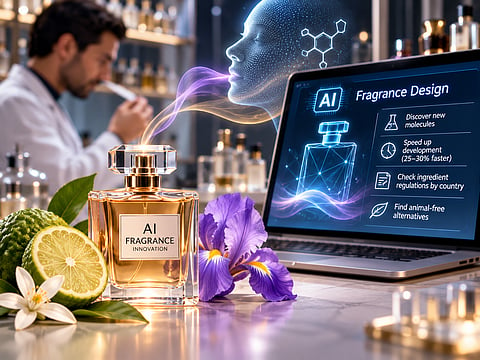
There may be a hint of bergamot in the top notes and sweet iris as a follow-up, but there is a noticeable dose of Artificial Intelligence emerging in new perfumes, according to industry specialists.
The traditional world of perfumes has not been able to turn up its nose to new technology and algorithms even though the industry insists that human sensorial expertise can never be fully replaced.
Get updated faster and for FREE: Download the Gulf News app now - simply click here.
The US cosmetics giant Estee Lauder opened a perfume innovation centre in Paris in 2025 that uses AI to mix savoir faire and cutting edge technology and help its billion dollars brands that include Jo Malone of London, Kilian Paris, Le Labo and Tom Ford Beauty, according to Lucas Nanini, the group's vice president for fragrance innovation.
He tests some of the new formulas uncovered on visitors to the Maison des Parfums.
"AI will allow us to work on what we call 'paradoxes'," Nanini told AFP. "For example, how can we create an oil that is rich, yet fine enough to be diffused?"
AI helps perfumers identify oils with properties that would take them years to develop by manual trial and error.
Machine intelligence also helps with regulatory tasks. Nanini highlighted the time it takes to check whether different countries allow each ingredient in a perfume.
With a single click he can now verify whether an ingredient from the one thousand-plus used is legal in a specific country as well as the maxium concentration allowed.
AI can also be used to find molecules to substitute for certain animal-derived ingredients.
Civet, taken from the glands of African civet and other cats in the species, was traditionally used to give perfume a musky tone but has been phased out in the face of animal rights protests.
Fast fragrance
International Flavors and Fragrances (IFF), another major US player, estimates that AI cuts between 25 and 30 percent of the time needed to develop and make a perfume.
With niche perfumes taking a bigger share of a growing market, enterprises like Givaudan of Switzerland and Robertet of France have heavily invested in tools to help them find new molecules.
IFF has developed its own AI tools using decades of internally collected data.
One suggests ingredients that complement each other and is used by IFF perfumer Tanguy Guesnet.
Also Read: Why perfume can feel like a time machine
"Every perfumer is searching for that 'accord' -- that combination -- that will spark the emotion of tomorrow," he said.
The tool looks at the molecules in a single ingredient and suggests others with similar characteristics. Mint essence, for example, contains menthone, and the tool can propose other ingredients that also include the compound.
"Some pairings might seem obvious, while others might appear a bit outlandish, but that is precisely the richness of the tool," said Guesnet.
"It stimulates creativity and so I consider highly original combinations."
Not everyone is convinced by the AI revolution, however.
Guillaume Teule, co-founder of the French fragrance house Helius, insisted that he remains in control of how a scent develops. "I maintain my own vision."
"Much like in music, resonances and dissonances emerge when you start altering ingredients -- and it is precisely these dissonances that are interesting, and which only a human being knows how to leverage effectively," he said.
"I don't believe any AI would have suggested 'Angel'," he said of Thierry Mugler's so-called 'gourmand' fragrance launched in 1992 and considered revolutionary because of its sweet notes.
"It was like a stone thrown into a pond, when it was first released," commented Teule.


