Obama needs to act, not talk
George S. Hishmeh writes: Muammar Gaddafi’s immediate ouster is critical given the mounting death toll and devastation in Libya
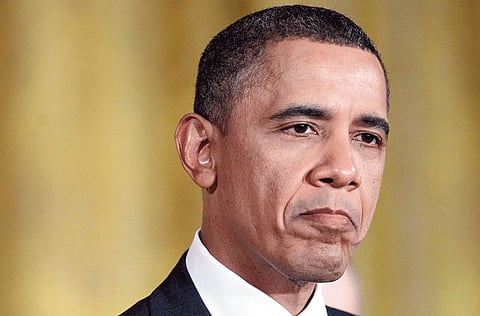
Where is Barack Hussain Obama? Why hasn't he done anything tangible to reassure the hundreds of thousands of freedom fighters marching in the Arab streets, from the Atlantic Ocean to the Arabian Gulf?
The admirable new Arab generation has so far been successful in overthrowing two long-ruling Arab leaders, the first in Tunisia and the second in Egypt, within weeks of each other.
There is no doubt that other autocrats are next in line, most prominently Muammar Gaddafi of Libya, who has correctly been labelled by US Secretary of State Hillary Clinton as "delusional".
More recently, Gaddafi has been described as "crazy" (by a prominent Arab journalist Jihad Khazen) and even a "lunatic" by American journalists.
Many others see him as a "murderous" despot following the reported bloodbath that the Libyan air force has inflicted on the protesters or revolutionaries — not ‘rebels' — as the western media has incorrectly described them.
Has the US president been twiddling his thumbs while the Arab world experiences a glorious and unprecedented revolution against these autocrats, often the favourite lackeys of key western leaders, probably because of the oil wealth in the region, estimated at 60 per cent of the world's output?
In all fairness, the Obama administration did send humanitarian aid to the besieged non-Libyans who took refuge in the liberated eastern provinces. Many foreign workers were also airlifted from the region to their countries of origin.
But ever since the outbreak of the turmoil in the North African region, the Obama administration has understandably been too cautious, primarily because of the war-weariness of the American people.
However, when the tidal wave of protests overwhelmed other Arab countries in the region, stretching from Yemen to Bahrain, the Obama administration regrettably became overly hesitant in taking a stand.
Playing on fears
Some of these states, close American allies, are either monarchies, oil-rich or fighting the Al Qaida, the underground guerrilla group that has plagued US troops in Iraq and Afghanistan at a terrible cost in human lives — Americans and Iraqi — not to mention the financial costs.
To justify his brutal action against the poorly armed resistance groups, the wily Gaddafi thought of banking on American and Israeli fears in the region.
In an interview to a French television channel, he outrageously defended his right to quell the uprising against his regime, of which he has been leader for 41 years, by comparing his action to Israel's war on Hamas in the Gaza Strip.
"Even the Israelis in Gaza," he said, "when they moved into the Gaza Strip [in 2008-09] they moved in with tanks to fight such extremists. It is the same thing here."
Military intervention
At the start of the uprising four weeks ago, the hallucinating Libyan leader also claimed that he was fighting the Al Qaida, whose presence in the country is extremely doubtful.
What the Obama administration fails to realise is that no one in the Arab world is begging for American military intervention, and there is a good reason for that.
Take the US intervention in Iraq. Thousands of people — American and Iraqi — have been killed in the eight-year-civil war. More importantly, there is also a fear that an American intervention may tarnish the image of the popular resistance.
Obama has a better standing of events abroad than any US president since John F. Kennedy, according to Joshua Muravchik, author of The Next Founders: Voices of Democracy in the Middle East."
Writing on the website Bitterlemons-international.org, Muravchik argued that Obama has "a wonderful ability to articulate ideas", and at this time "he should be scourging the dictators and encouraging the people".
But all Obama did when he discussed the situation in Libya with British Prime Minister David Cameron over the telephone recently was "agree to press forward with planning, including at Nato, on the full spectrum of possible responses, including surveillance, humanitarian assistance, enforcement of the arms embargo, and no-fly zone".
For the record, Obama and Cameron also repeated that their common objective must be "an immediate end to brutality and violence; the departure of Gaddafi from power as quickly as possible and a transition that meets the Libyan people's aspirations for freedom, dignity, and a representative government".
Well and good, but how long will this take, how many more Libyan lives will be lost and how many more Libyan towns and cities will be wiped out? Both leaders should be aware that time is running out and the sooner they reach this goal the better it is for all the Arabs in the region. Besides, the reward for the two countries may be sky high.
George Hishmeh is a Washington-based columnist. He can be contacted at ghishmeh@gulfnews.com.


