A democratic flaw led to the Blair hubris
Let Britain hold prime ministers personally to account at the ballot box
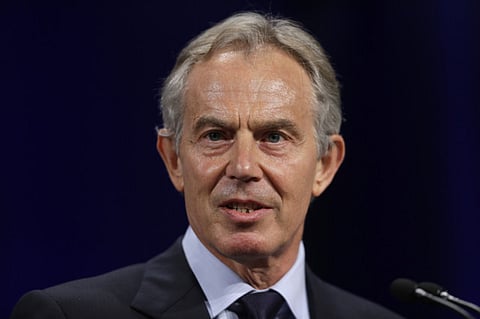
I marched with a million others in London on that memorable day in 2003 against the impending Iraq invasion. In uncharitable moments, I would happily see the prime minister who used the “dodgy dossier” to send young British men to their deaths arraigned for war crimes. Whatever Tony Blair’s apologia for his misjudgements this week, his first offence was a commonplace one shared by every prime minister before and since. He failed to tell the truth about Britain’s lost power to the British people.
Part of Britain’s post-imperial conceit is that it has to show international leadership on any issue that titillates its ravening tabloids: Any outrage anywhere on the planet is something that British foreign secretaries are expected to influence. Send a gunboat. Send in the brave boys. Mourn the run-down of United Kingdom forces, as Daily Mail columnists did earlier this week, as if the days of unilateral intervention had not died with Suez in 1956 — the occasion of another prime ministerial lie.
Any modern society contains such a mesh of interwoven institutions that it takes a brave politician to pull everything up by the roots. Brute force has too many limits and usually brutalises those who use it, as well as those who succumb. Within a year, Blair’s and George W. Bush’s idealistic gift of democracy to the Iraqi people had degenerated into the atrocities of Abu Ghraib.
The lessons, though, are mainly for the US, since Britain is the tag-along-Tonies of US power. On Afghanistan — an intervention sanctioned by the United Nations Security Council and therefore mercifully beyond legal reproach — much of the UK policy effort tried to anticipate where the Washington debate was moving so that Britain did not look flat-footed when US announcements came. There has been no independent UK policy. Foreign Secretary William Hague clearly has an appreciation of the new limits to British power. In the week when the Islamic State in Iraq and the Levant (Isil) rebels began to rewrite the Sykes-Picot settlement of Iraq and Syria, and were feared close to Baghdad, Hague decided that his most useful immediate role was several good photo opportunities with Brad Pitt and Angelina Jolie. The Canadianisation of British politics continues. As hard power atrophies, soft power seduces.
The original tag-along-Tony was of course Blair. We need to see the Chilcot report into Iraq before a definitive history, but Blair’s modus operandi was to leave the Conservative opposition no space to reasonably attack him from the right. In foreign policy, that translated into a desire to march in lockstep with the US and close down the charge that Britain was insufficiently supportive of its closest ally. This was new: Harold Wilson, as Labour prime minister, was excoriated for many an ignoble compromise. He had more geo-strategic reasons than Blair, during the Cold War, to hug the US close. Yet, to his credit, Wilson repeatedly refused, despite the pleadings of Lyndon Johnson, a Democrat president, to send even a solitary bagpiper in solidarity to Vietnam.
Except in the smallest conflicts such as in Sierra Leone, a British prime minister has to act in concert. In Libya, Britain rightly provided air cover for the Benghazi rebels only with French support after UN resolutions, and with US sanction and then help.
It is arguable that the Commons reaction last August to Prime Minister David Cameron’s attempt to intervene in Syria shows that prime ministerial hubris has been tamed, but that is too grand an interpretation for a fumbling mishandling of MPs. Do not expect anyone to be happy about breaking off family holidays to turn up to vote. That defeat was a Downing Street cock-up, not parliamentary accountability.
Iraq is one of the many incidents — take General Communications Headquarters snooping for another — that show that checks and balances on the prime ministerial prerogative are still too weak. The Commons is not a fierce and fearless watchdog like Congress and no amount of formal fiddling with procedures — select committees or requirements for a Commons vote before war — are enough to give it teeth. These are merely the dignified formalities that disguise where power really lies and which will make no difference as long as the Commons is so intimately bound up with the executive. Ministers have to be MPs or peers. The ambition of so many MPs to become ministers themselves enfeebles its scrutiny. If they want preferment, they must be loyal to their party leader and future prime minister. In short, the prime minister has corrupting patronage over the people meant to hold him to account. This informal power is what makes the Commons craven.
If Britain wants public debate and independent votes before it goes to war, or erode its civil liberties, it needs to divide prime ministers from their Commons troops. Britain needs to start by electing them independently from among nominated candidates — perhaps people who have 500,000 signed supporters from at least 50 constituencies — with a second vote alongside a first vote for the local MP. That will allow party leaders to stand, but also the occasional Ross Perot or Ralph Nader.
Let prime ministers choose not just MPs or peers, but anyone to be a minister, as the US president can do. Britain will get at least two important gains: A more competent executive and a more independent legislature. Britain will hold prime ministers personally to account at the ballot box and between elections. It may even generate enthusiasm by giving the voters more choice. Get the Commons off its knees to do its worst and elect the prime minister directly. Give the voters power over prime ministerial government and a future million-strong protest will force the prime minister to sit up and take notice.
— Guardian News & Media Ltd
Chris Huhne was formerly Liberal Democrat MP for Eastleigh and secretary of state for energy and climate change.


