Yearning for snow
These are the moments I will miss as we move deeper into a warming world
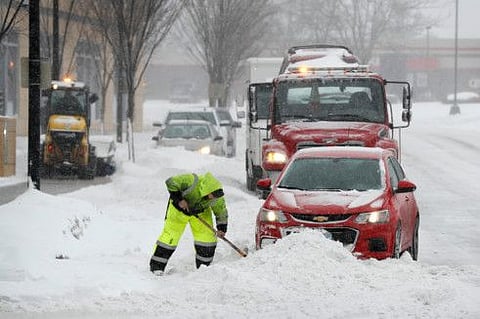
It used to snow here [in Hastings-on-Hudson, New York . Not all the time. Not like Vermont or the Adirondacks in upstate New York, where it snows on and off all winter, barely registering a mention at the corner store.
But in Westchester County, New York, and other parts of the Northeast, you could reliably turn the calendar from November to December and know that if there was going to be precipitation, it would probably arrive in the form of snow, not rain. Now it only seems to rain. This winter the rain has been so unrelenting that mud season has stretched across the once-frigid months of January and February.
Sure, we had one good snowfall, on Jan. 18, with a few inches of accumulation that lasted a couple of days. But as recently as 10 or 15 years ago, our children could expect a handful of snow days a year, sometimes using up their five-day allotment. (This winter the school district has yet to use one.) And the occasional blizzard would reliably bury our yards and streets under two or three feet of snow.
I used to document those snow events for The New York Times, where I often had the task of writing the weather story from my perch in the White Plains bureau. On March 7, 2003, my opening on one such article was simply “Ugh.” It wasn’t just that it was snowing in March, but that it had already snowed so many times that winter that Central Park had recorded 45 inches, double the seasonal snowfall average then of 22 inches. So far this winter, Central Park has recorded just 4.8 inches.
With climate change startling the world with its acceleration in recent years, a lack of snowfall is admittedly among the least of anyone’s worries. Australia’s people and animals succumbed to horrendous fires that burnt an area roughly the size of South Korea. Fearsome heatwaves swept across Europe; in France, nearly 1,500 died. Catastrophic floods ravaged Southeast Asia. It is a taste of the world we have sowed with runaway carbon emissions.
aWhen clumps of snowdrop flowers appear prematurely next to my driveway, their comely blossoms a harbinger of spring, I think of all the other mismatches unfolding in nature. Mild winters are unable to beat back invasive pests like the hemlock woolly adelgid, many of which will die off only at 4 or 5 degrees below zero. Some songbirds heading north on their annual migrations, governed by changes in light, will arrive too late for the feast of insects whose emergence is set off by warmer temperatures.
I realise that one year does not signal a shift in climate, which is marked by 30-year trends in temperature and precipitation, and that climate is not to be confused with weather. But worldwide, each of the last five years was among the five hottest ever recorded, according to the National Oceanic and Atmospheric Administration, and the last two decades have included 19 of the warmest years since record keeping began.
Some parts of the country have already reached the ominous threshold of a 2-degree Celsius rise in temperature, or 3.6 degrees Fahrenheit, above preindustrial levels. That is the point beyond which, many scientists say, cataclysmic and irreversible changes in climate will occur, and that the Paris climate agreement (the one President Trump is withdrawing us from) aimed to keep the world below.
Olden times
When it snowed the joys were visceral. Yes, snow stings and turns grey and complicates commuting. But when it is new and fresh, there is nothing sweeter: walking through a light snow, the usual sounds magically muffled; experiencing the vicarious thrill of a child’s first sledding expedition; seeing a cardinal alight on a bird feeder, red against white; striking up a conversation with a neighbour shovelling on a street where interaction is limited or nonexistent; lighting a fire as snow swirls outside.
These are the moments I will miss as we move deeper into a warming world. Bill McKibben, the climate activist and author of several books on climate change, recently told a conference in Manhattan that we cannot solve this problem “one Prius at a time.” But I am nonetheless taking ownership of the climate crisis (or climate emergency, as some prefer), vowing never again to buy a car that uses gasoline and signing a contract this month with a solar company to install panels on our roof. It is surely too little, and probably too late. But if nothing else, it is my homage to the snow.
— Lisa W. Foderaro is a journalist and a columnist.


